
Choosing a Social WiFi Marketing Platform
In Brief: A social WiFi marketing platform connects guest internet access with consent-based data collection, branded portals, promotions, analytics, surveys, and customer engagement. Businesses should choose a platform that combines these marketing capabilities with reliable access control, centralized management, security, and multi-location scalability.
Guest WiFi used to be a basic amenity. Now it is part of the revenue stack, the customer data stack, and the operational stack. A social wifi marketing platform sits at the intersection of all three, turning internet access into a controlled entry point for branding, data collection, promotions, feedback, and repeat visits.
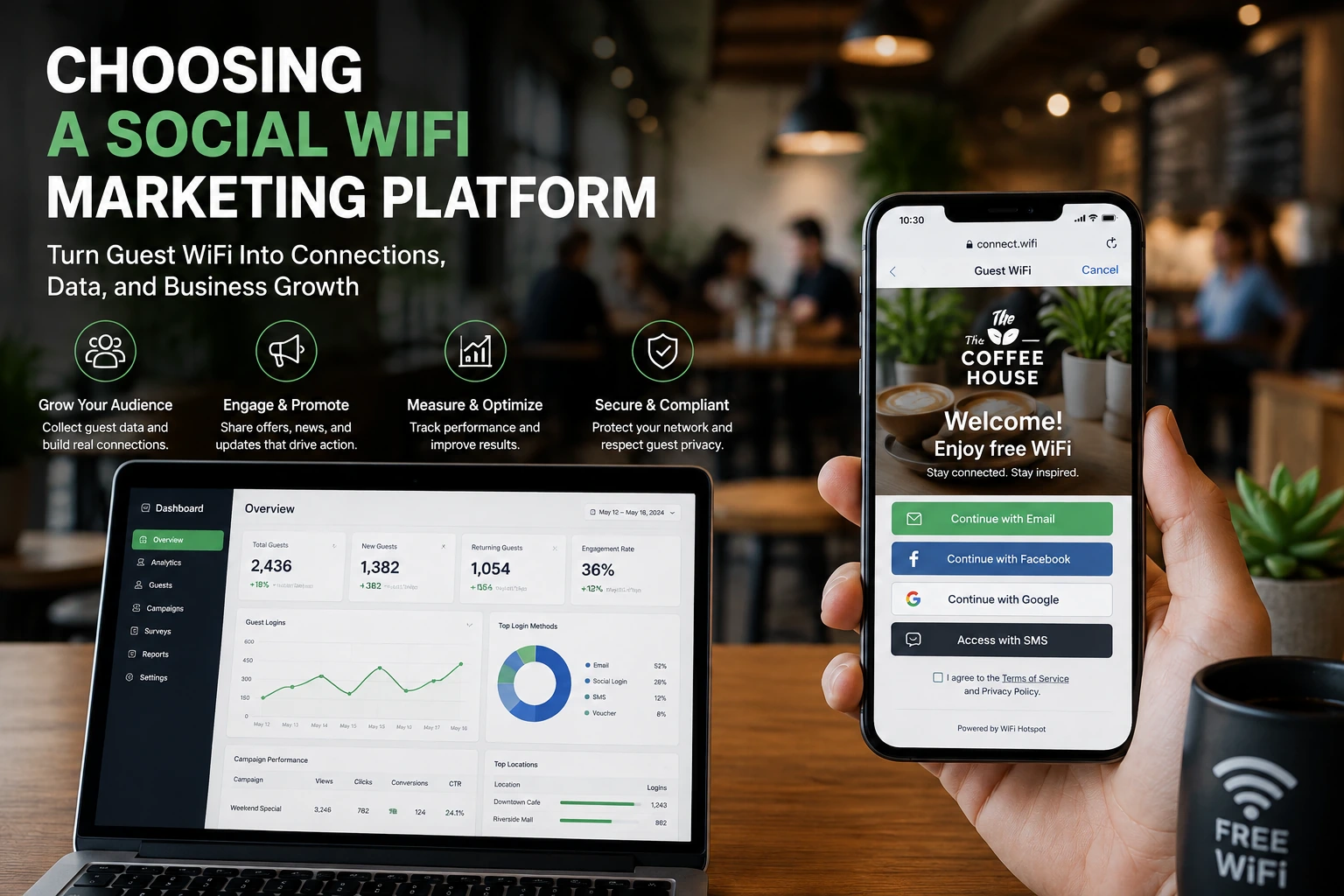
For hospitality groups, retailers, airports, healthcare facilities, schools, and service providers, that shift matters. If guest access is fast but unmanaged, the business misses a chance to identify visitors, shape the user journey, and measure on-site engagement. If guest access is managed but disconnected from marketing, the network does its job without producing much business value. The right platform closes that gap.
What a social wifi marketing platform actually does
At a practical level, the platform manages how guests connect to WiFi and what happens before, during, and after that connection. Instead of offering an open network with no visibility, businesses can present a branded captive portal, require login through email or social profiles, collect consent, display ads or promotions, and route data into reporting or campaign workflows.
That sounds simple, but the difference between a basic hotspot tool and a serious platform is significant. A business-grade system also needs policy control, session management, analytics, user segmentation, hardware compatibility, and centralized administration across one site or hundreds. In other words, marketing features only matter if the network layer is reliable, secure, and manageable.
This is why buyers often evaluate social WiFi and guest access software through two lenses at once. Operations teams want stability, policy enforcement, and easy rollout. Commercial teams want data capture, customer insights, promotions, surveys, and measurable campaign performance. A strong platform serves both without forcing trade-offs that create extra work later.
Why businesses are replacing basic guest WiFi tools
Many venues start with a consumer-grade router or a fragmented setup built from separate networking and marketing products. That can work in a single small location, but the limits show up quickly. Branding is inconsistent, reporting is thin, consent records are hard to manage, and every location behaves a little differently.
A centralized social wifi marketing platform gives operators more control. They can standardize login flows, apply access policies by site, launch location-specific promotions, and review usage patterns across the full network. That is especially important for chains, managed service providers, and public venues where uptime, consistency, and auditability matter as much as the guest experience.
The business case is also broader than lead capture. Hotels use guest WiFi to segment travelers and promote upgrades. Restaurants use it to drive repeat visits and gather feedback while the experience is still fresh. Retailers use it to support loyalty enrollment and local campaigns. Airports and transit operators use it to manage large volumes of temporary users while maintaining visibility and control. In each case, WiFi is no longer just connectivity. It is an owned digital touchpoint.
Core capabilities to look for in a social wifi marketing platform
The starting point is a branded captive portal that is easy to configure by venue, brand, or campaign. That includes custom login pages, sponsorship space, multilingual support, and device-aware presentation. If the front-end experience feels generic or clumsy, conversion rates usually suffer.
Authentication options are the next layer. Some venues want social login to reduce friction and enrich profile data. Others prefer email login, SMS, voucher access, paid access, or terms-only authentication. In regulated or high-security environments, IT teams may need tighter identity controls or AAA Radius integration. The best platforms support multiple methods because user expectations and compliance requirements vary by industry.
Analytics should go beyond total sessions and bandwidth consumption. Decision-makers need to see new versus returning visitors, dwell patterns, campaign engagement, opt-in rates, survey responses, and site-level performance. Those metrics make guest WiFi useful to operations, marketing, and management at the same time.
Automation is another major factor. A platform should make it easy to trigger follow-up messages, segment users by location or behavior, and present different portal content based on venue type or time of day. Without that layer, teams collect data but struggle to act on it.
Then there is administration. For multi-site environments, cloud management is often the fastest path to standardization. For enterprises, governments, universities, and service providers, on-premise deployment may still be necessary for compliance, internal policy, or architectural reasons. A flexible platform should support both models without forcing a compromise on features.
The trade-offs buyers should think through
More data capture is not always better. Asking guests to complete long forms or use a specific login method can reduce sign-ins, especially in high-traffic environments like cafes, airports, and quick-service venues. If the venue depends on low-friction access, a lighter onboarding flow may produce better overall results than an aggressive data-collection strategy.
Social login can add convenience and profile value, but it should not be the only option. Some users do not want to connect personal accounts to public WiFi. Others may be using business-managed devices that limit the flow. Email, click-through, voucher, and paid access options give operators room to match the experience to the setting.
Cloud management simplifies rollout and remote administration, but some organizations still need local control. Hospitals, banks, public agencies, and large education networks often have stricter infrastructure requirements. In those cases, a platform with both cloud-hosted and on-premise deployment models is usually the safer long-term choice.
There is also a difference between feature depth and feature usability. A platform can offer surveys, video ads, custom splash pages, payment acceptance, and advanced analytics, but if daily management requires specialist effort, adoption drops. Buyers should evaluate how quickly staff can launch campaigns, update portals, and interpret reports without constant vendor intervention.
Industry fit matters more than generic feature lists
A hotel group and an airport may both want guest WiFi, but their operating realities are not the same. Hotels need branded login journeys, repeat guest recognition, and options for premium access or upsell messaging. Airports need high concurrency, session control, advertising inventory, and policy consistency across terminals. Restaurants may prioritize quick access, promotions, and review generation. Hospitals may focus on visitor access, security, and multilingual portals.
That is why generic comparisons can be misleading. The right social wifi marketing platform is the one that fits the venue model, traffic pattern, compliance needs, and internal ownership structure. In some organizations, marketing owns the campaigns while IT owns access control. In others, network administrators need a single console that can support branding and policy management together.
Providers that understand this tend to design around real deployment scenarios rather than isolated features. That includes support for mixed hardware environments, reseller or white-label requirements, centralized policy templates, and monetization options such as paid WiFi, sponsored access, or advertising.
How to evaluate platform value before rollout
A good evaluation starts with the business outcome, not the login screen. If the goal is repeat visits, assess segmentation and follow-up workflows. If the goal is monetization, look closely at payment support, ad delivery, and access packages. If the goal is operational control, focus on centralized management, reporting depth, and deployment flexibility.
It also helps to test the platform under real conditions. Can a busy venue staff member update a portal without technical help? Can IT enforce different policies by location while keeping brand consistency? Can management see useful performance data without exporting raw logs into another system? Those questions reveal whether the software will create momentum or overhead.
For enterprises and service providers, scale should be tested early. Multi-tenant administration, role-based access, controller options, Radius integration, and broad access point compatibility can become critical once the network moves beyond a pilot. A platform like Start Hotspot is built for that crossover point where guest WiFi must satisfy both infrastructure demands and business-growth objectives.
Why this category keeps gaining importance
Businesses have fewer direct, permission-based touchpoints with on-site visitors than they did a few years ago. At the same time, they are expected to personalize experiences, prove campaign performance, and operate securely across distributed locations. Guest WiFi answers part of that challenge because it is both a service people actively use and a channel the venue controls.
That does not mean every business needs the most complex setup. Some sites need a fast branded portal with basic analytics. Others need payment acceptance, surveys, video promotion, and centralized administration across regions. The key is choosing a platform that can support the current use case without limiting future expansion.
A social wifi marketing platform is at its best when guests barely notice the technology, IT trusts the control model, and the business can clearly tie access activity to revenue, retention, or service quality. That is where guest WiFi stops being a utility and starts becoming an asset worth managing with intent.
Prefer Antamedia on Google
Get practical guest WiFi and network management insights directly from Antamedia.