
Choosing a WiFi Billing System for Hotspots
In Brief: A WiFi billing system connects guest authentication, internet plans, payment processing, and access policies so users can purchase and receive WiFi automatically. Businesses should evaluate payment flexibility, session and bandwidth controls, reporting, hardware compatibility, and centralized management before choosing a hotspot billing platform.
A guest opens a laptop in your lobby, airport lounge, cafe, or clinic and expects WiFi to work in seconds. If access requires payment, that step has to be just as fast. A wifi billing system for hotspots sits right in the middle of that moment. It decides whether the experience feels professional and profitable, or frustrating and easy to abandon.
For operators, this is not just a payment feature. It is part of the access stack, the customer journey, and the revenue model. The right platform has to authenticate users, apply the right plan, process payment, enforce session rules, and still give IT teams centralized control. That is why choosing the wrong system creates more than checkout problems - it creates support tickets, refund requests, inconsistent policies, and lost opportunities to monetize guest access.
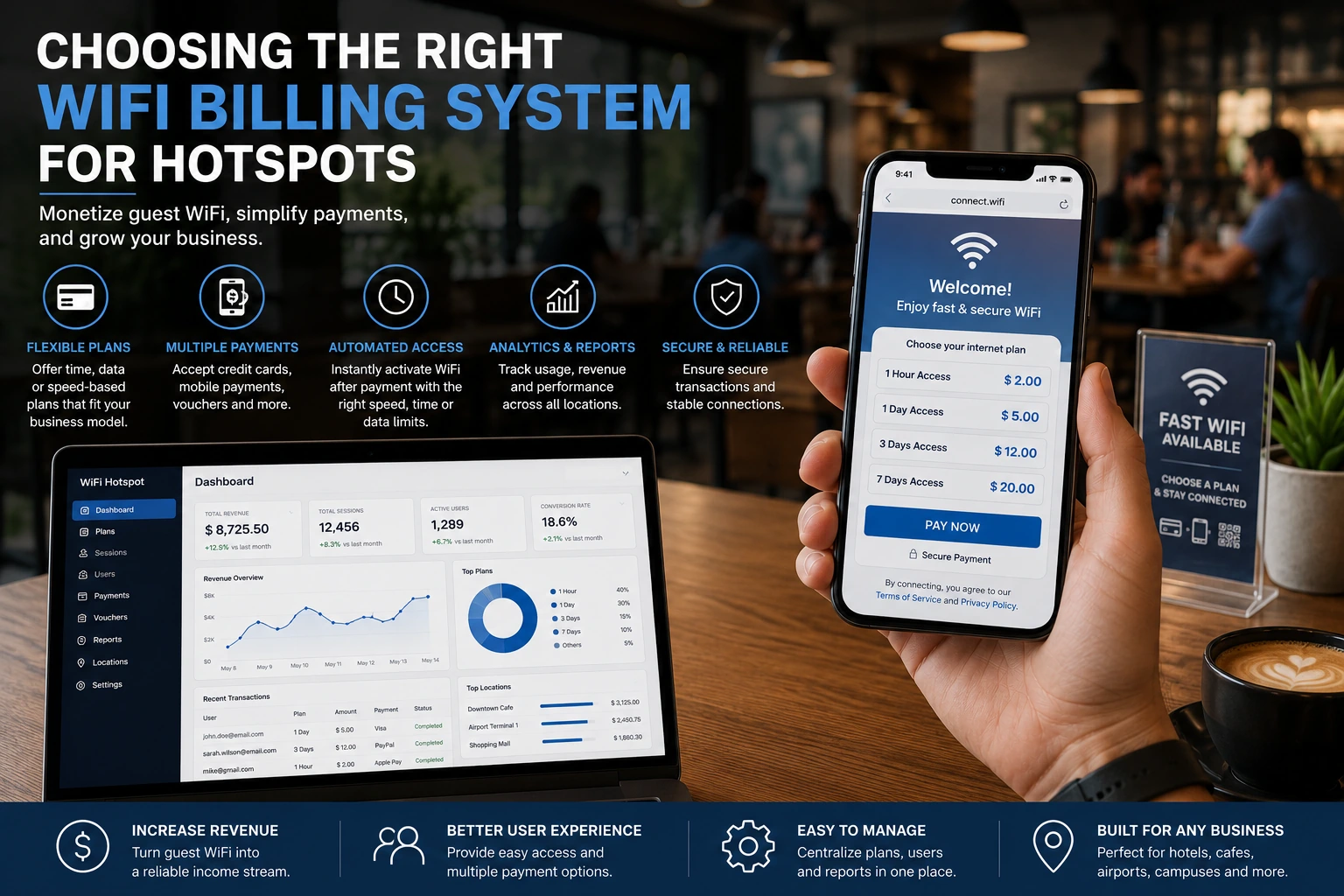
What a wifi billing system for hotspots actually does
At a basic level, hotspot billing software sells internet access. In practice, it does much more. It connects the captive portal, user authentication, session management, device policies, and payment processing into one operational flow.
A user connects to the SSID, lands on a branded portal, selects a package, pays, and receives access based on the rules you define. Those rules may include time limits, bandwidth caps, data quotas, device count, location-based pricing, voucher validation, or recurring access for longer stays and memberships.
For a hotel, that might mean offering complimentary basic access and charging for higher speed tiers. For a transit hub, it may mean selling short-duration plans to travelers. For a managed service provider, it could mean deploying branded hotspot billing across dozens of client venues while keeping administration centralized. The software needs to support each of those models without forcing manual work at the site level.
Why billing cannot be separated from access control
Many venues start by treating payments as an add-on. They already have WiFi, so they assume they only need a simple paywall. That approach usually breaks down quickly.
Billing only works well when it is tied directly to policy enforcement. If a customer pays for four hours, the platform must reliably start and stop that session. If they pay for premium bandwidth, traffic shaping has to reflect the plan purchased. If they roam between access points or reconnect later, the system needs to maintain session continuity and usage records.
This is where infrastructure matters. A hotspot billing platform is not just an e-commerce page placed in front of a network. It has to coordinate with captive portal logic, Radius or AAA services, controller behavior, user databases, and venue-level settings. Without that coordination, operators end up with mismatched records, users who paid but cannot connect, or plans that are sold but not enforced correctly.
The business case for paid hotspot access
Not every venue should charge for WiFi. In many environments, free guest access supported by data capture, promotions, or advertising creates more value than direct billing. But there are clear cases where paid access makes commercial sense.
Hotels, campgrounds, marinas, conference venues, transport terminals, and temporary event spaces often have users willing to pay for speed, duration, or premium access. Some businesses use billing to offset bandwidth costs. Others use it to create tiered service, where basic access remains free and higher-value users self-select into paid plans.
There is also a control benefit. Charging for certain types of access can reduce abuse, discourage non-customer usage, and align consumption with available capacity. In high-density environments, that matters. The network has to serve legitimate users first, and billing can help structure demand rather than simply opening the door to unlimited use.
Core features that matter most
The best buying decision usually comes down to whether the platform fits your operating model, not whether it has the longest feature list. Still, several capabilities are non-negotiable.
The first is flexible billing logic. You should be able to define plans by time, bandwidth, quota, device count, or service level, and apply them by venue, group, or user segment. A single-location cafe may keep this simple. A multi-property hospitality group will need far more granularity.
The second is payment support. That includes secure payment acceptance, support for local and international customer expectations, tax handling where needed, transaction records, and refund management. If users cannot complete payment quickly on mobile, conversion drops. If staff cannot verify transactions easily, support costs rise.
The third is branded captive portal control. Billing should feel like part of your guest experience, not a disconnected gateway page. Branding, messaging, package presentation, and language options all influence whether users trust the transaction enough to complete it.
The fourth is centralized administration. Multi-location operators need one place to manage plans, pricing, policies, portal design, analytics, and user records. Without central control, every new site adds operational drag.
Finally, reporting matters. Finance teams need revenue visibility. Operations teams need insight into plan adoption and usage trends. Marketing teams may want to compare free access, sponsored access, and paid access performance by location.
Cloud, on-premise, or hybrid depends on your environment
Deployment model is often overlooked until procurement or security review slows everything down. For some organizations, a cloud-managed billing platform is the fastest route to rollout. It simplifies updates, central management, and scaling across distributed venues.
For enterprises, government environments, healthcare organizations, universities, or service providers with stricter infrastructure requirements, on-premise or hybrid models may be more appropriate. Those environments may need local control over authentication, compliance workflows, or integration with existing network architecture.
There is no universal winner here. Cloud is often easier to deploy and manage. On-premise may offer stronger alignment with internal policy and network design. The right choice depends on security requirements, team capability, network topology, and how much standardization exists across locations.
Common mistakes when evaluating hotspot billing
One of the most common mistakes is buying based on portal appearance alone. A polished payment page looks good in a demo, but it says very little about session reliability, policy enforcement, hardware interoperability, or multi-site administration.
Another mistake is ignoring hardware compatibility. Billing software has to work well with the access points, gateways, controllers, or routers already in place - or with the hardware you plan to standardize on. If support is partial, deployment becomes a patchwork.
Operators also underestimate guest support scenarios. What happens if a user changes devices, loses connection mid-session, or purchases the wrong package? Billing systems should make these cases manageable without forcing staff into manual troubleshooting.
A final issue is treating billing as a standalone revenue tool instead of part of a broader guest access strategy. In many venues, the strongest return comes from mixing models: free access for customer acquisition, paid upgrades for premium usage, sponsored access for campaigns, and analytics to track behavior across all of it.
How to choose the right system for your venue or network
Start with the business model, not the software demo. Are you monetizing premium bandwidth, selling session time, offering vouchers, enabling tenant billing, or creating white-label hotspot services for clients? Your answer shapes everything from package design to reporting needs.
Next, map the operational reality. How many locations are involved? Who manages pricing changes? Do front-desk or support staff need transaction visibility? Will users expect self-service only, or do you need staff-issued access options too? A system that works in one property can become inefficient across fifty if administration is not designed for scale.
Then test the full user flow. Do not just validate login. Test payment, reconnection, roaming, expiration, receipt handling, and support resolution. The right platform should reduce friction for guests and reduce intervention for staff.
It is also worth looking beyond direct billing. A platform that combines hotspot monetization with guest access control, social login, surveys, advertising, and analytics gives operators more ways to turn WiFi into a measurable business asset. That matters when customer expectations shift or when a venue wants to move from paid access to hybrid monetization later. This is where platforms like Start Hotspot tend to stand out - they are built for both network control and commercial use cases, not one or the other.
The best systems support growth, not just transactions
A wifi billing system for hotspots should not box you into a single pricing model or venue type. Businesses grow, service levels change, and customer behavior is not static. The system you choose today should support additional locations, new package structures, stronger branding, broader integrations, and different monetization strategies without forcing a rebuild.
That is the real evaluation standard. Not whether the platform can take a payment, but whether it can keep access policies, customer experience, and revenue operations aligned as your network expands. When those pieces work together, hotspot billing stops being a narrow technical function and becomes a controlled, scalable part of the business.
Frequently Asked Questions
Can a WiFi billing system offer both free and paid access?
Yes. Businesses can provide free basic access while charging for longer sessions, higher speeds, larger data allowances, or premium service plans.
What should happen after a guest completes a WiFi payment?
The system should automatically create or activate the appropriate access plan and allow the guest to connect without requiring manual intervention from staff.
Can WiFi billing plans limit speed, time, and data usage?
Yes. Professional hotspot billing systems can apply session duration, bandwidth speed, traffic quota, expiration, and device limits according to the purchased plan.
Prefer Antamedia on Google
Get practical guest WiFi and network management insights directly from Antamedia.