
Hotel Guest WiFi Management That Pays Off
In Brief: Hotel guest WiFi management combines reliable connectivity with authentication, bandwidth control, network segmentation, captive portals, analytics, billing, and centralized administration. A well-managed system can reduce support workload, improve the guest experience, support PMS-based access, and create opportunities for premium services and customer engagement.
A guest checks in after a delayed flight, drops a bag in the room, and connects three devices before even touching the minibar. That moment says a lot about hotel guest wifi management. If access is slow, confusing, or insecure, the property feels dated fast. If it works well, the guest notices less - and that is usually the point.
For hotel operators, WiFi is no longer a basic utility. It affects review scores, staff workload, upsell opportunities, brand perception, and in some cases direct revenue. It also creates pressure on IT teams that need to secure the network, support multiple property layouts, and keep service levels consistent across guest rooms, conference areas, restaurants, and back-office systems.
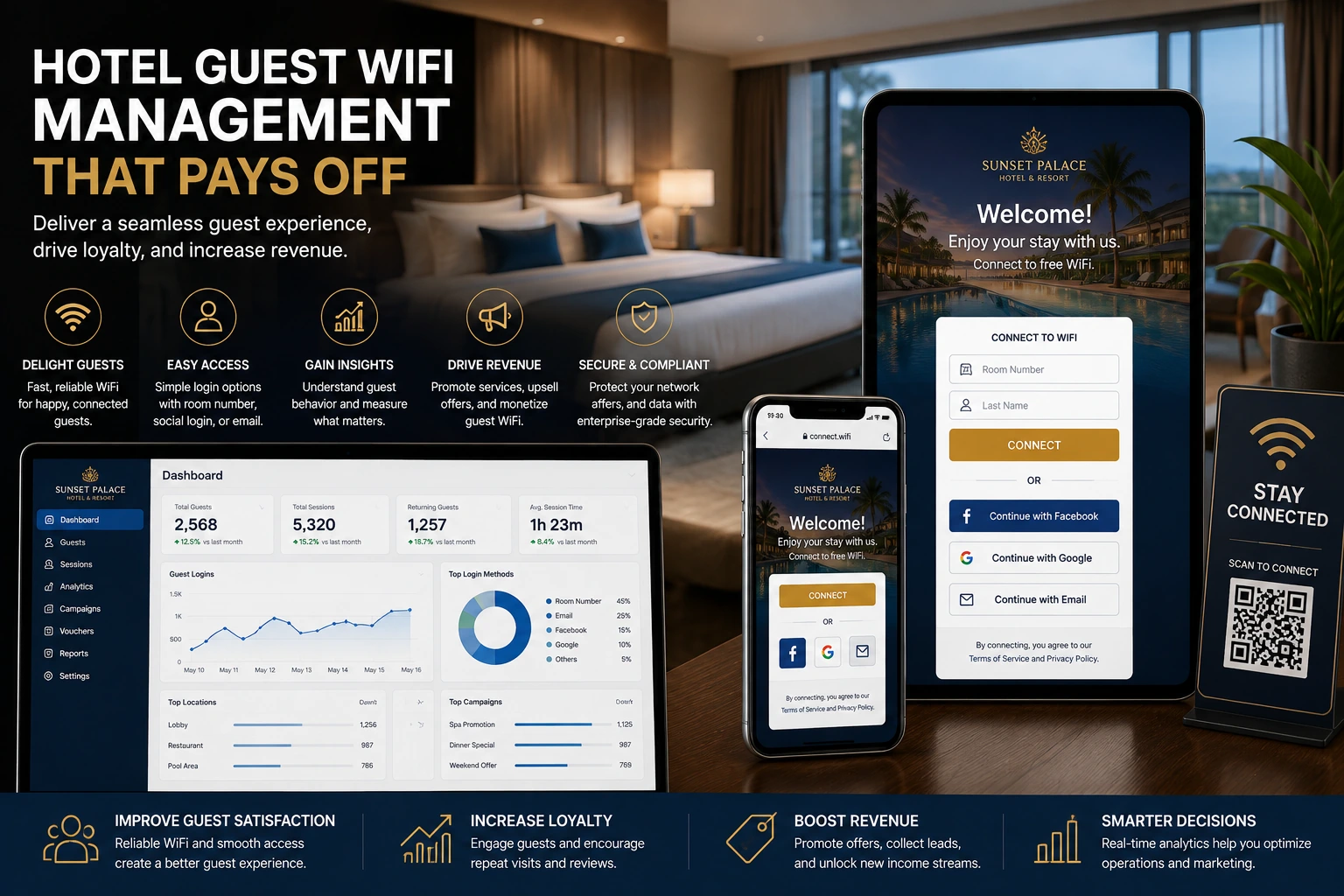
What hotel guest wifi management really includes
Hotel guest wifi management is not just putting a password at the front desk. It is the system behind authentication, bandwidth control, user segmentation, captive portals, analytics, billing, policy enforcement, and centralized administration. In a hotel environment, those functions need to work together because guest traffic is unpredictable and service expectations are high.
A small boutique property may only need branded access, rate limiting, and basic reporting. A large hotel group may need multi-property control, voucher systems, PMS integration, tiered access plans, ad-supported login, and separate policy rules for guests, staff, vendors, and event attendees. The right setup depends on the business model of the property, not just the square footage.
That distinction matters. Hotels are not managing internet access for a static user base. They are serving short-stay visitors with different devices, different usage patterns, and very little patience for login issues.
Why hotels need more than basic WiFi access
The operational cost of poor WiFi shows up in places many properties underestimate. Front desk staff become informal tech support. Corporate event clients complain about unstable connectivity. Guests leave negative reviews over a service the hotel may still treat as secondary infrastructure.
A managed guest WiFi platform reduces that friction by giving operators more control over how access is delivered. Instead of a one-size-fits-all network, the hotel can create different experiences for different users and spaces. A guest in a standard room may receive complimentary access with reasonable speed limits. A premium guest or conference organizer may receive higher bandwidth or dedicated credentials. Staff devices stay isolated from guest traffic. Marketing teams can use the login flow to collect opt-ins, promote amenities, or request survey feedback.
This is where the business case becomes stronger. Good WiFi management supports hospitality operations, but it can also support occupancy strategy, ancillary revenue, and brand consistency.
The core capabilities that matter most
The first requirement is access control. Hotels need to decide who gets online, for how long, on how many devices, and under what conditions. Captive portals remain useful because they let the property present a branded login page, enforce terms of use, and support multiple authentication methods such as room number and last name, voucher code, social login, or paid access.
The second requirement is network segmentation. Guest traffic should not touch internal business systems, POS networks, or administrative endpoints. This is not a cosmetic feature. It is a basic security control, especially for properties with restaurants, spas, retail, or conference operations running on the same physical site.
Bandwidth management is equally important. A hotel does not need to block streaming outright to maintain service quality, but it does need policy controls. Rate limits, quotas, traffic shaping, and time-based access rules help prevent a small number of high-consumption users from degrading performance for everyone else.
Centralized management becomes essential as soon as a property group has more than one location. IT teams need visibility into usage trends, device counts, access point status, login success rates, and service issues without traveling site to site. Cloud-based administration is attractive here, though some hotel groups still prefer on-premise deployment for compliance, latency, or internal policy reasons. It depends on the organization’s governance model and internal resources.
Hotel guest wifi management and the guest experience
The best guest WiFi experience is usually the one that requires the least explanation. Clear login flows, stable coverage, and fast reconnection matter more than flashy design. That said, branding still has value when it is used with purpose.
A captive portal can reinforce the hotel brand and reduce confusion by making the access process look official and trustworthy. It can also present upgrade offers, promote dining or spa services, highlight loyalty benefits, or direct guests to digital concierge tools. For conference and event traffic, custom splash pages and temporary access options help the hotel serve organizers without burdening the front desk.
There is a balance to strike. If the login process asks for too much information or interrupts the user too often, conversion drops and frustration rises. Hotels should collect only the data they can use and justify. For some properties, that means a light-touch login focused on speed. For others, especially resorts or marketing-driven brands, richer data capture may support remarketing and guest lifecycle campaigns.
Security is not optional
Guest WiFi is a public-facing service, which means it is also a public-facing risk surface. Hotels need policy enforcement that protects users and the business without making access difficult. Secure authentication, VLAN separation, content filtering where appropriate, session controls, and detailed logging all contribute to a safer deployment.
Hotels with payment workflows, regulated data exposure, or larger conference operations may also need stronger controls such as AAA Radius support, policy-based authorization, and more advanced monitoring. This is especially relevant for enterprise hospitality groups, managed service providers, and mixed-use properties.
Security choices should match the hotel’s actual risk profile. A limited-service property and a convention hotel will not have the same requirements. What they do share is the need for clear separation between guest traffic and business-critical systems.
Revenue and marketing opportunities inside the network
Many hotels still treat guest WiFi as a cost center, but managed access can support measurable commercial outcomes. Paid premium access is one model, though it is not right for every property. In upscale and business-focused segments, guests may expect basic connectivity to be free, while paying for higher-speed tiers, conference packages, or event-specific access remains viable.
Advertising and promotions inside the login journey can also generate value when used carefully. A hotel can promote room upgrades, late checkout, food and beverage offers, local partnerships, or loyalty enrollment. Survey prompts after login or at session end can help gather feedback while the stay is still active.
The strongest long-term value often comes from analytics. Hotels can track connection volumes, repeat visitors, peak usage windows, and engagement with portal content. That data helps operations teams size infrastructure and helps commercial teams refine campaigns. A platform like Start Hotspot is built for this overlap between network control and business growth, which is exactly where many hotel WiFi projects now succeed or fail.
Choosing the right model for your property
There is no single best architecture for every hotel. A small independent hotel may prioritize simplicity, fast deployment, and low-touch cloud management. A regional group may need centralized policies across multiple sites with local flexibility. An enterprise brand or public-sector hospitality environment may require on-premise control, white-label options, hardware interoperability, and deeper authentication infrastructure.
The right decision usually comes down to four factors: how many properties are involved, how much internal IT support is available, whether the WiFi service needs to generate revenue or marketing data, and what security or compliance standards must be met.
Hotels should also think beyond day-one deployment. The platform has to scale with room expansions, renovation cycles, conference demand, seasonal occupancy changes, and hardware refreshes. Buying for current needs alone often creates expensive limits later.
Where deployments often go wrong
The most common mistake is treating guest WiFi as a one-time install instead of an ongoing service layer. Hardware may be in place, but policy design, portal strategy, reporting, and support workflows remain weak. That leaves hotels with connectivity but not real management.
Another mistake is overcomplicating the experience. More features are not always better. If social login, surveys, payment options, and promotional content all appear at once, the result can feel like friction rather than service.
Finally, some operators focus only on bandwidth and ignore administration. Speed matters, but so do visibility and control. If staff cannot quickly create access plans, troubleshoot login issues, or compare performance across properties, the system will cost more in labor than expected.
Hotel guest wifi management works best when it is treated as part of the property’s operating model, not just its IT stack. The network sits at the intersection of guest satisfaction, security, and commercial performance. Hotels that manage it deliberately turn a routine expectation into a better-controlled, more profitable service.
Prefer Antamedia on Google
Get practical guest WiFi and network management insights directly from Antamedia.