
How Do You Choose Guest WiFi Software for Multiple Locations?
In Brief: Multi-location guest WiFi software should provide centralized control over authentication, access policies, captive portals, security, analytics, and location-specific configuration. Businesses should also evaluate deployment flexibility, hardware compatibility, scalability, data management, and whether the platform can support both IT requirements and commercial guest engagement.
A guest network becomes a business system the moment users depend on it, marketing wants data from it, and IT has to manage it across more than one location. That is why multi-location guest WiFi software needs to combine centralized control, security, analytics, and flexible access policies. It is not just a login page or a way to hand out internet access. It is the layer that controls who connects, how they connect, what data is captured, what policies are enforced, and whether the network supports business goals instead of creating support tickets.
For a hotel, that might mean separating guest, staff, and back-office traffic while maintaining brand consistency across properties. For a restaurant group, it could mean collecting customer opt-ins and pushing time-based promotions. For an airport, hospital, school, or retail chain, the requirement is often larger - centralized control, role-based access, usage policies, analytics, and a system that can scale without becoming harder to operate.
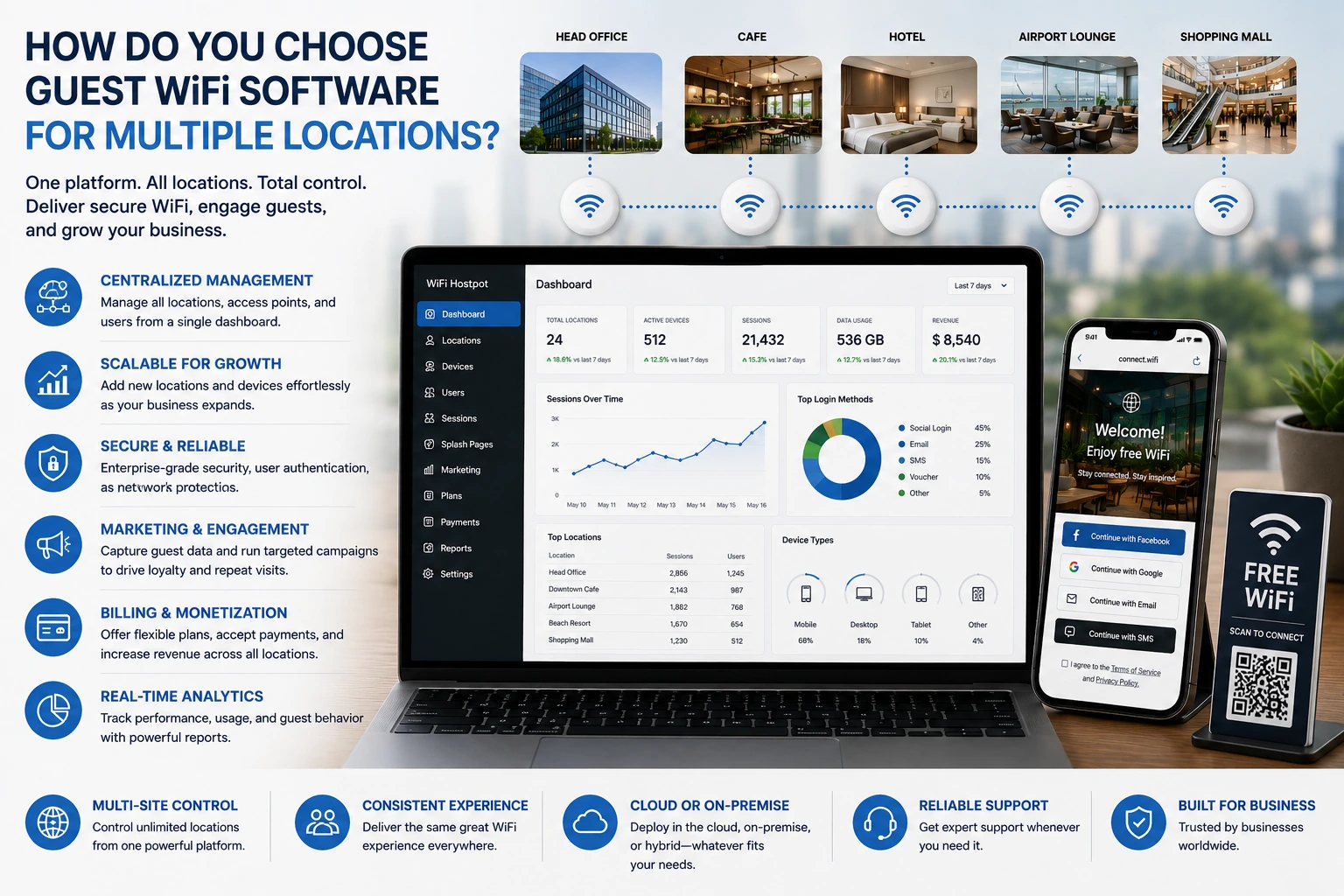
Why Multi-Location Guest WiFi Needs Centralized Management
Guest WiFi software is often defined too narrowly. Some vendors mean a splash page builder, while others mean controller software. Others mean controller software. In practice, strong guest wifi management software sits between the network infrastructure and the customer experience.
It should give operators control over authentication methods, captive portal workflows, access duration, bandwidth limits, fair use policies, and session management. It should also support commercial functions such as social login, lead capture, customer surveys, advertising, payment collection, and reporting. If the platform cannot connect operational control with measurable business outcomes, it solves only part of the problem.
That distinction matters when organizations expand. A single-site coffee shop may only need branded access and a basic portal. A regional retail group may need location-level campaign control and centralized analytics. A managed service provider or enterprise network team may need white-label options, multi-tenant administration, Radius integration, on-premise deployment, and compatibility with mixed hardware environments.
What Should You Look for in Multi-Location Guest WiFi Software?
The first requirement is policy control. Guest access should be easy for users but precise for administrators. That means defining access rules by site, user type, time window, device class, voucher, payment status, or authentication source. It also means controlling idle timeout, session limits, speed, and data quotas without manual intervention.
The second is captive portal flexibility. A portal is not just a branded entry screen. It is where businesses shape first impressions, collect consent, and guide users into the right access journey. Some venues need one-click access. Others need email registration, SMS verification, room-number validation, voucher login, staff-assisted access, or paid internet tiers. Software should support all of that without forcing custom development for every use case.
The third is centralized management. Multi-location operators cannot afford to configure every site separately. They need a cloud dashboard or centrally managed platform that can push templates, monitor usage, update policies, and review site health from one place. That reduces administrative overhead and creates consistency, especially for franchise groups, hospitality brands, education networks, and public venues.
The fourth is analytics with business value. Connection counts alone are not enough. Decision-makers want repeat visits, dwell time, conversion rates on portal campaigns, customer demographics where permitted, ad performance, opt-in rates, and survey responses. IT teams want device visibility, session history, bandwidth usage, and troubleshooting data. Good software serves both audiences.
Security and compliance are not optional
Guest access introduces risk because the users are unmanaged, the devices are unknown, and the traffic is unpredictable. The right platform should isolate guest traffic from internal systems, support secure authentication flows, maintain detailed logs, and help administrators enforce acceptable use policies.
This is especially important in healthcare, education, banking, transportation, and government-linked environments, where compliance and auditability can carry as much weight as convenience. Even in less regulated sectors, the expectation is clear: users want frictionless access, but businesses cannot trade away security to get it.
There is also a practical side to compliance. Consent capture, terms acceptance, privacy messaging, and data retention settings need to be configurable. A marketing team may want customer information, but the software has to collect and store it in a way that aligns with local requirements and internal policy. That balance between acquisition and governance is where many basic hotspot tools fall short.
Why deployment flexibility matters
Not every organization should run the same model. Cloud management is a strong fit for businesses that want speed, easy rollout, and centralized administration without maintaining local servers. It works well for restaurant groups, retail chains, hospitality operators, and smaller IT teams that need fast deployment across sites.
On-premise deployment still matters for enterprises with stricter security requirements, regulatory demands, or infrastructure standards that limit cloud dependency. Large campuses, public institutions, telecom environments, and certain enterprise networks may require local control of authentication, logging, and user data.
The best guest wifi management software supports both models or gives buyers a clear path based on operational needs. Flexibility is not a feature for the brochure. It affects procurement, rollout speed, security review, and long-term scalability.
Guest WiFi is now a revenue and engagement channel
For many venues, free internet access is no longer enough of a business case. WiFi has become a direct customer touchpoint. That changes what buyers should expect from the platform.
A hotel can offer tiered access, promote upgrades, and collect post-stay feedback. A shopping center can use branded login pages and targeted campaigns to drive foot traffic to tenants. A cafe chain can build repeat marketing lists from returning visitors. Transit operators can display sponsored messages or video advertising. In each case, the network is doing more than carrying traffic - it is supporting revenue, engagement, and customer insight.
That does not mean every organization should turn guest access into a marketing machine. In hospitals and schools, the priority may be reliable access and controlled messaging. In airports or large public spaces, monetization may make sense only for premium tiers or sponsorships. The point is that software should support these models where they fit, not force them where they do not.
Common buying mistakes
One of the most common mistakes is choosing software based only on the captive portal design. The portal is visible, so it gets attention, but the harder questions sit underneath it. How are users authenticated? Can access rules vary by site? Can staff issue vouchers quickly? Does the platform work with existing access points and gateways? Can reports be exported in a way the business can actually use?
Another mistake is underestimating scale. A system that works well for two sites may become difficult at twenty or two hundred. Template management, delegated administration, monitoring, and multi-tenant support become much more important as the footprint grows.
A third mistake is separating IT goals from commercial goals during evaluation. If IT buys for control only, marketing may end up with no usable tools for customer engagement. If operations buys for lead capture only, IT may inherit a system with weak policy control or poor compatibility. The right decision usually comes from evaluating both sides together.
How to Evaluate Guest WiFi Software Before You Buy
Start with the operating model, not the feature list. Define who will manage the system, how many locations are involved, which hardware is already deployed, and whether cloud or on-premise is the better fit. Then map the access journeys you need: open access, social login, vouchers, room-based authentication, paid access, or segmented user roles.
From there, assess how the platform handles administration, policy control, branding, analytics, and integrations. Review security logging and user data handling early, not at the end. If monetization, advertising, or surveys matter, test those workflows with the same scrutiny as login performance and network policy enforcement.
If new sites are added, a managed service partner takes over operations, or the business launches new guest campaigns, a mature guest WiFi platform should support that growth without requiring a platform replacement.
The best buying decision is rarely the one with the longest feature sheet. It is the platform that gives IT teams control, gives operators flexibility, and gives the business a clear return from every guest connection. When guest WiFi is managed well, it stops being a utility and starts becoming an asset you can measure, improve, and grow.
Frequently Asked Questions
Can each location have different guest WiFi policies?
Yes. A multi-location platform should allow central standards while supporting different access methods, session limits, bandwidth policies, portals, and campaigns by location.
Does multi-location guest WiFi require the same hardware everywhere?
Not necessarily. Software with broad compatibility can support mixed infrastructure, but each router, controller, access point, and firmware combination should be confirmed before deployment.
Should guest WiFi software support both Cloud and On-Premise deployment?
That flexibility is useful for organizations serving different customer or regulatory requirements. Cloud, On-Premise, and Hybrid models can each be appropriate depending on infrastructure and data-control needs.
Prefer Antamedia on Google
Get practical guest WiFi and network management insights directly from Antamedia.