
How Do You Manage WiFi Access Points Across Multiple Locations?
In Brief: WiFi access points across multiple locations are easier to manage through a centralized platform that provides consistent configuration, monitoring, policy control, firmware management, and troubleshooting. Centralized management reduces configuration drift and on-site administration while allowing businesses to manage guest access and network policies across many locations.
When a guest WiFi issue hits ten locations at once, the problem is no longer about a single access point. It becomes an operations problem, a support problem, and often a revenue problem. That is why managing APs across multiple locations has become a practical requirement for businesses that depend on guest connectivity, branded access, and centralized control.
For hotels, restaurants, airports, retail chains, hospitals, schools, and managed service providers, the old model of logging into each device locally does not scale well. It creates inconsistent policies, slow troubleshooting, and too many chances for configuration drift. A cloud-managed approach changes that by moving visibility, policy control, monitoring, and updates into one administrative layer that can cover one site or hundreds.
Why Managing WiFi Access Points Across Multiple Locations Gets Difficult
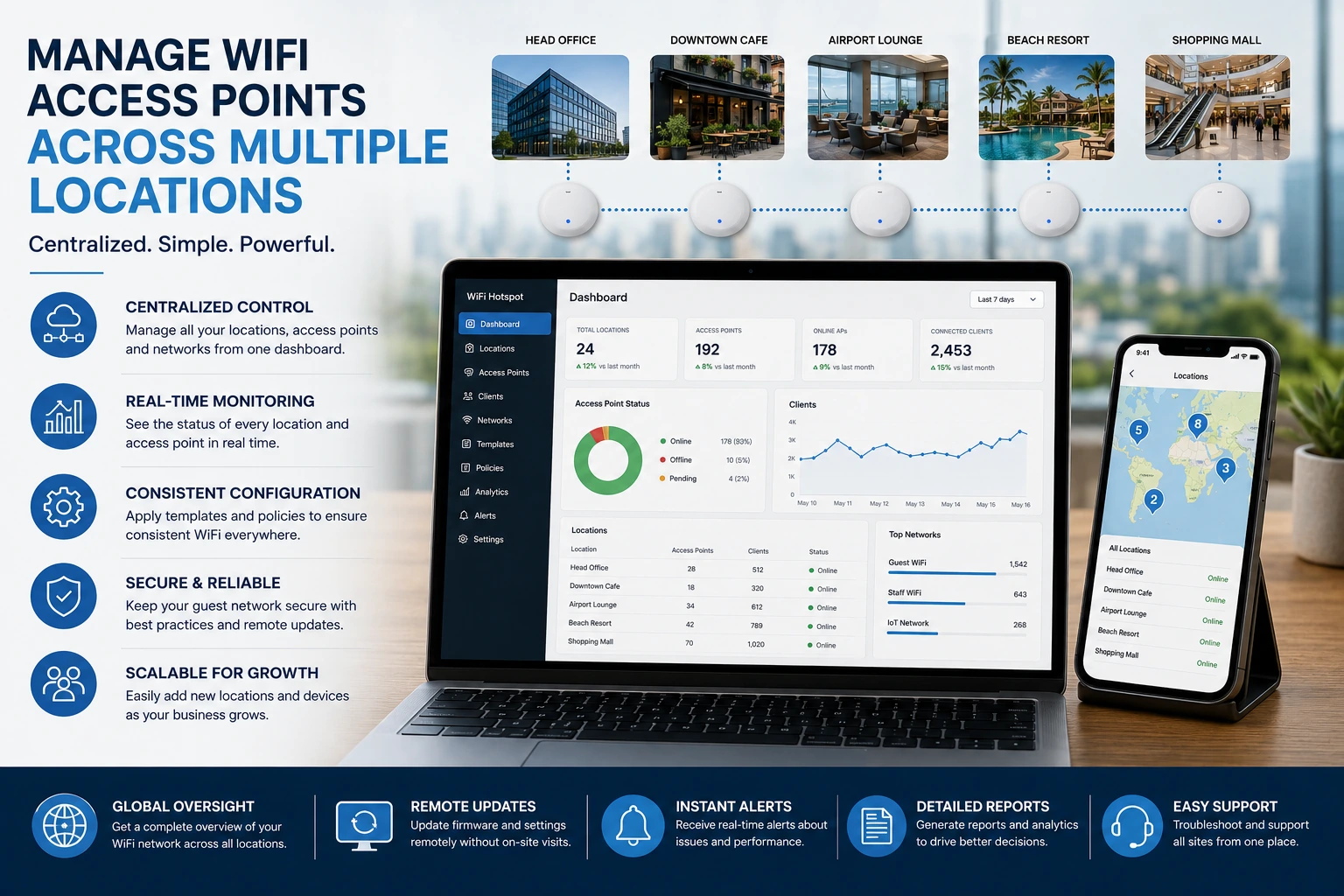
Managing WiFi access points across multiple locations becomes difficult when each site has separate configurations, local device access, different firmware versions, and inconsistent network policies. As the number of locations grows, configuration drift, slower troubleshooting, and dependence on on-site staff can quickly increase operational overhead. The access points stay on site, but the control plane for administration lives in a web-based environment that authorized teams can reach from anywhere.
That sounds straightforward, but the value is bigger than remote login. A proper platform lets you apply SSIDs across multiple locations, segment guest and staff traffic, enforce captive portal rules, monitor device health, push firmware, collect analytics, and standardize policy without touching each access point manually.
For businesses running guest WiFi, cloud management also connects networking with customer-facing functions. That includes branded splash pages, social login, voucher access, payment collection, advertising, surveys, and usage reporting. In other words, the WiFi network stops being just infrastructure and starts operating as a managed business asset.
How Centralized WiFi Management Solves Multi-Site Problems
The difference is most obvious when operations expand beyond a single venue. A cafe with one location can survive with ad hoc administration for a while. A restaurant group with forty stores cannot. Neither can a hotel brand, transit operator, or healthcare system that needs consistent performance and security across properties.
Centralized cloud management reduces the friction that usually comes with growth. New sites can inherit templates instead of being configured from scratch. Policy changes can be rolled out broadly in minutes. Support teams can identify whether an issue is isolated, regional, or system-wide without waiting for on-site staff to interpret technical symptoms.
It also improves accountability. Administrators can see which locations are online, which access points are overloaded, when devices last checked in, and where user sessions are failing. That visibility matters for uptime, but it matters just as much for customer experience. If guests cannot connect, stay online, or complete portal login, the business impact is immediate.
The operational benefits go beyond convenience
The first benefit most teams notice is speed. Provisioning is faster, updates are easier, and support is more efficient. But convenience alone is not a strong enough reason to change architecture. The real value comes from consistency, control, and lower operational risk.
Cloud management helps standardize configurations across every location. That includes radio settings, SSIDs, VLAN assignments, user access rules, splash page behavior, and bandwidth limits. Standardization reduces errors, which is especially important when multiple teams, franchise operators, or external providers are involved.
Security management also improves, although the exact result depends on the platform and deployment model. Centralized credential changes, role-based access, audit trails, and policy enforcement are easier to manage from a single interface. Guest traffic can be isolated from internal business systems, and suspicious patterns can be investigated without being physically present.
There is also a strong commercial case. For guest WiFi operators, a managed platform can support revenue generation and customer engagement alongside network administration. Captive portals, paid access, digital advertising, and customer data collection become easier to operate when the same platform controls both the access layer and the guest workflow.
What Should You Centralize Across All Locations?
Not every cloud platform is built for the same type of deployment. Some are designed mainly for internal enterprise WiFi. Others are stronger in guest access, monetization, or hospitality workflows. The right fit depends on what the network is supposed to achieve.
If guest WiFi is part of the business model, look beyond basic provisioning and monitoring. The platform should support branded captive portals, flexible authentication methods, landing page customization, vouchers, social WiFi options, analytics, and policy segmentation between guest and staff networks. If paid WiFi matters, billing and payment support should be native rather than bolted on.
Hardware compatibility matters too. Some organizations prefer tightly integrated ecosystems. Others need software that works across multiple access point brands because they already have mixed infrastructure or want procurement flexibility. That choice affects cost, rollout speed, and long-term control.
Reporting is another area where differences show up quickly. IT teams need device health, uptime, usage trends, and alerts. Operators and marketing teams may need visitor counts, repeat visits, dwell time, login conversions, survey results, or ad performance. A platform that serves only the network layer may leave business teams blind.
Trade-offs businesses should evaluate early
Cloud management is not a one-size-fits-all decision. For many organizations, it is the best operational model. For others, especially those with strict compliance, data residency, or internal control requirements, the answer may be more nuanced.
The first trade-off is dependence on the management platform. If the vendor has an outage or a service issue, administration can be affected. Well-designed systems reduce this risk by allowing access points to continue serving users even if the cloud management layer is temporarily unavailable, but buyers should verify how this works in practice.
The second trade-off is around customization and control. Some cloud platforms simplify deployment by limiting low-level configuration options. That is helpful for standard rollouts, but less helpful for organizations with unusual environments, advanced AAA requirements, or highly customized policy logic.
Then there is the deployment model itself. Some enterprises want cloud-hosted management because it reduces internal overhead. Others need on-premise or hybrid deployment for governance reasons. A flexible software vendor is often a better fit than a vendor that forces a single architecture on every customer.
Cloud management and guest WiFi monetization
This is where the topic becomes especially relevant for public-facing venues. A business that offers guest WiFi is not only managing radios and SSIDs. It is managing the customer entry point to digital engagement.
When centralized WiFi management is paired with captive portal software, analytics, and marketing tools, the network becomes easier to monetize and measure. A venue can sell premium access, display promotions, collect customer data with consent, run surveys, present video ads, or push offers during login. Those functions are much easier to control centrally than site by site.
For multi-location operators, central management also keeps branding consistent. The portal experience at one hotel, airport, or retail site can match the rest of the network while still allowing local variations. That balance between central control and local flexibility is often where cloud platforms prove their value.
This is also why modern WiFi management platforms attract operational and commercial stakeholders, not just network administrators. The buyer is often looking for fewer support tickets, but also more usable customer data, stronger engagement, and a clearer return from WiFi infrastructure.
Who Benefits Most From Centralized Multi-Location WiFi Management?
The strongest use cases tend to share the same pressures: multiple sites, guest traffic, limited on-site IT resources, and a need for consistency. Hospitality groups need branded WiFi and simple support across properties. Retailers need network visibility across stores and customer engagement at login. Airports and transit operators need scale, uptime, and flexible access policies. Schools and hospitals need segmentation, user control, and easier administration across large campuses.
Managed service providers and resellers also benefit because centralization improves service delivery. They can support many customer networks from one interface, apply standards more reliably, and offer value-added services instead of only basic maintenance.
Single-site businesses can benefit too, but the urgency is lower unless guest WiFi is tied directly to customer experience or revenue. If the network is simple and static, the business case may be modest. If the venue depends on branded access, paid plans, recurring campaigns, or usage insight, cloud management becomes more attractive even at smaller scale.
Choosing for the next stage of growth
The best cloud WiFi decision is rarely about features alone. It is about whether the platform can support the business three years from now without forcing a redesign. That means evaluating scalability, hardware support, deployment flexibility, guest access capabilities, analytics depth, and the commercial tools wrapped around the network.
A good platform gives IT teams tighter control while making the WiFi estate easier to operate. A better platform also helps the business capture more value from every guest session. If your access points are already part of the customer journey, central management should do more than keep them online. It should help the network perform like an asset, not just a utility.
Frequently Asked Questions
Do all locations need to use the same access point model?
Not necessarily. A hardware-flexible management platform may support multiple compatible routers, access points, and controllers, although exact model and firmware compatibility should always be verified.
Can WiFi policies be different at each location?
Yes. Centralized management should allow common templates while supporting location-specific SSIDs, access policies, captive portals, bandwidth settings, and administrative permissions.
What is the main advantage of centralized WiFi management?
It reduces configuration drift and on-site administration by allowing monitoring, policy changes, troubleshooting, and configuration to be handled from one management environment.
Prefer Antamedia on Google
Get practical guest WiFi and network management insights directly from Antamedia.