
Is Cloud WiFi Worth It for Small Businesses?
In Brief
Cloud WiFi can be worth the investment when a small business uses it as both an internet access system and a customer engagement channel. By collecting consent-based guest data, displaying timely offers and automatically sending email, SMS or WhatsApp campaigns after a visit, the business can encourage customers to return and measure which promotions perform best.https://antamedia.com/features/wifi-marketing/
For a small business, the value of cloud WiFi should not be measured only by the cost of providing internet access.
A basic WiFi password gives customers connectivity, but it provides the business with almost no information about:
Who is visiting
How often customers return
Which location they visit
Which offers interest them
Which campaigns encourage another visit
Which customers have not returned recently
A cloud-managed WiFi platform can transform that anonymous network traffic into consent-based customer relationships.
Restaurants, cafés, bars, salons, gyms, clinics, retail stores, coworking spaces, small hotels and other local businesses can use guest WiFi to collect useful customer information, promote services while guests are present and continue communication after they leave.
The key question is therefore not simply:
“How much does cloud WiFi cost?”
A better question is:
“Can the system help the business generate enough repeat visits, customer engagement or operational value to justify its cost?”
What Value Does Cloud WiFi Provide to a Small Business?
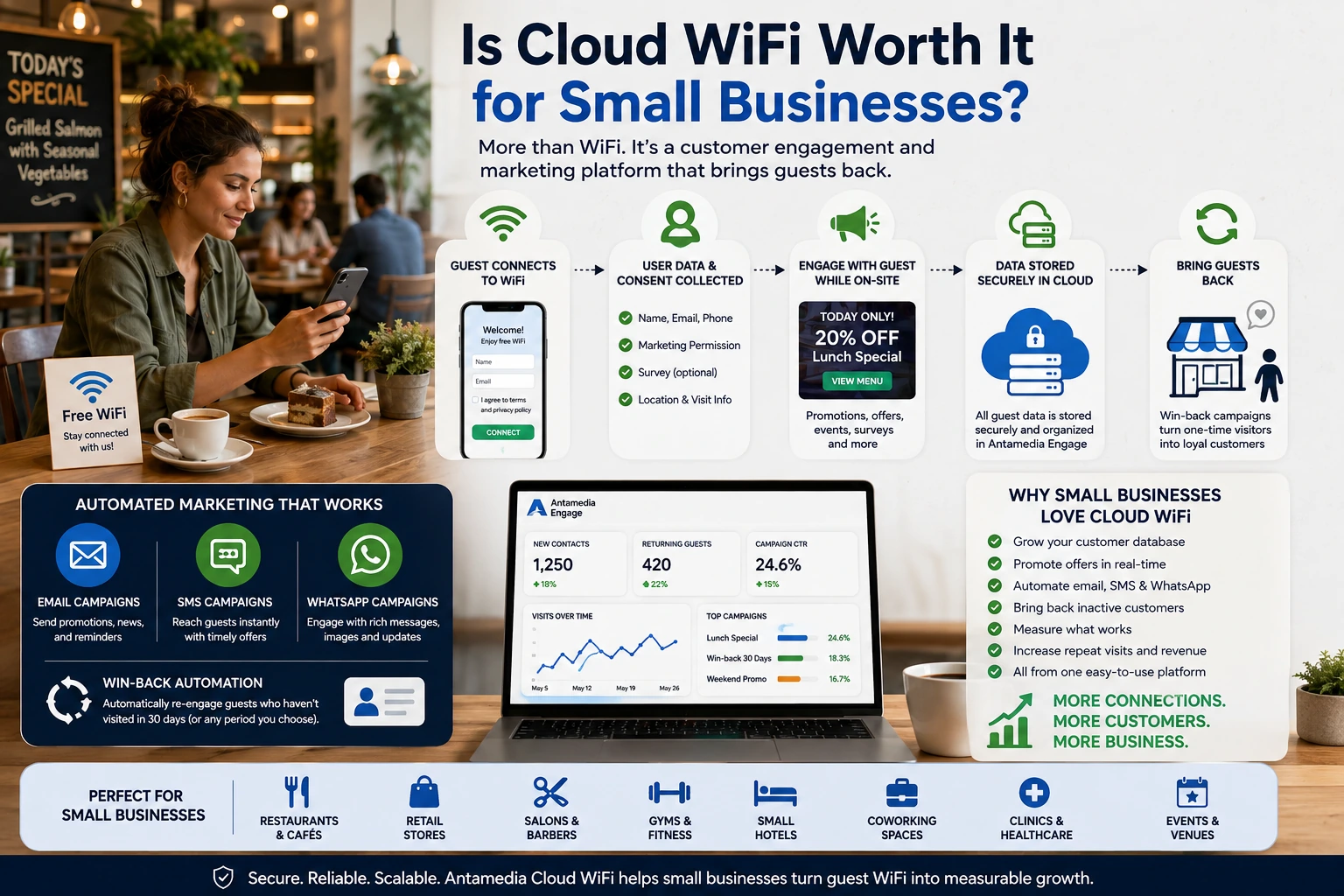
Cloud WiFi can provide value in four connected areas:
Controlled and reliable guest internet access
Collection of consent-based customer data
Automated marketing before, during and after a visit
Analytics that show visitor activity and campaign performance
The first benefit is operational. The business no longer needs to share one permanent WiFi password with every guest.
The remaining benefits are commercial.
Instead of treating WiFi as a utility expense, the business can use it to build a customer database, promote relevant products and encourage visitors to return.
Antamedia WiFi Hotspot can collect consent-based customer data through splash pages, surveys and guest access forms. This information can be organized in Antamedia Engage for segmentation, campaign history and follow-up communication.
From Anonymous WiFi Users to Known Customers
With a traditional shared WiFi password, a restaurant may know that 300 devices connected during the month, but it usually does not know who those visitors were.
A WiFi Hotspot login flow can ask the guest to provide selected information before internet access is granted.
Depending on the business and its privacy requirements, this may include:
First name
Email address
Mobile number
Date of birth
Preferred services
Reason for the visit
Survey answers
Contact permission
The objective should not be to collect as much information as possible.
A small business should collect only the data it can use responsibly and explain clearly why the information is requested.
For example, a café may need only a first name, email address and marketing consent. A beauty salon may also ask which services interest the customer. A small hotel may collect different information based on its guest communication requirements.
Once permission is collected, the business can continue the relationship after the WiFi session ends.
The Real Benefit: Marketing After the Guest Leaves
Many small businesses communicate with customers only while they are physically present.
A waiter may mention a promotion. A poster may advertise an event. A retail employee may explain a discount.
Once the customer leaves, the communication normally ends.
Cloud WiFi changes this process by allowing the business to create a consent-based follow-up workflow.
A guest can connect to WiFi, provide contact permission and later receive:
A thank-you message
A discount for the next visit
A feedback request
A loyalty reward
An event invitation
A new service announcement
A birthday offer
A reservation reminder
A limited-time promotion
A request to review the business
Antamedia supports follow-up through email, SMS and WhatsApp, depending on the configured communication provider, campaign settings and guest consent. Campaigns can be based on first connection, time intervals, inactivity, selected guest activity, location or customer segment.
This gives a small business a practical way to continue marketing without manually exporting contact lists and sending each message separately.
Automated Post-Visit Marketing
Post-visit marketing can begin after the guest disconnects or after a configured period following the visit.
For example, a restaurant can create this automation:
Trigger: A guest visits the restaurant and connects to WiFi.
Condition: The guest has provided contact permission.
Action: Send a thank-you email two hours after the visit.
Message: Thank the guest, include a feedback link and offer a discount on the next weekday lunch.
The campaign runs automatically for every eligible guest.
Staff do not need to remember who visited, when the customer left or which message should be sent.
The same concept can be used by other small businesses:
A salon sends aftercare instructions and a rebooking link.
A gym sends information about membership options after a trial visit.
A clinic sends permitted follow-up information.
A retail store sends a coupon for a related product category.
A small hotel promotes direct booking for a future stay.
A coworking space sends a day-pass or membership offer.
Bringing Back Customers Who Have Not Returned
One of the most valuable automations for a small business is an inactivity or win-back campaign.
The business can identify customers who have not returned to the WiFi location for a defined period, such as 30 days.
A typical automation could be:
Trigger: The customer has not returned for 30 days.
Condition: The customer previously visited a selected location and provided contact permission.
Action: Send an email, SMS or WhatsApp message.
Offer: Return this week and receive a complimentary dessert, service upgrade, discount or loyalty reward.
This is more targeted than sending the same promotion to every person in the customer database.
The campaign is directed toward customers who already know the business but may need a reason to return.
Antamedia email campaigns can be scheduled according to guest inactivity, activity, WiFi location and selected customer segments. The system can also retain campaign history for subsequent analysis.
Example: Restaurant 30-Day Win-Back Campaign
Audience: Guests who have not returned in 30 days
Channel: Email or WhatsApp
Message: “We have not seen you recently. Visit us this week and enjoy a complimentary dessert with your main course.”
Validity: Seven days
Measurement: Returned WiFi users, coupon redemptions and resulting sales
Example: Salon Rebooking Campaign
Audience: Customers whose last visit was 45 days ago
Channel: SMS
Message: “It may be time for your next appointment. Book before Friday and receive a complimentary treatment upgrade.”
Measurement: Booking link clicks and completed appointments
Example: Small Hotel Return Campaign
Audience: Previous guests who have not returned within six months
Channel: Email or WhatsApp
Message: Direct-booking offer with an included breakfast or room upgrade
Measurement: Direct booking code, link clicks and repeat guest identification
Marketing While the Customer Is Still at the Location
Cloud WiFi marketing does not begin only after the guest leaves.
The splash page, welcome page and post-login experience can display relevant promotions while the visitor is physically present.
This is particularly useful when the offer depends on:
Time of day
Day of the week
WiFi location
Customer segment
Visit frequency
Current campaign
Seasonal event
Available service capacity
Antamedia WiFi marketing can display image or video promotions during the WiFi journey and redirect guests to selected pages after login. Campaigns can promote menus, coupons, events, services, app downloads, surveys or loyalty programs.
Time-Based Promotions
A small business can show different promotions at different times.
For example, a restaurant can display the daily special during the lunch peak:
Time: 12:00–15:00
Audience: Guests connecting at the restaurant
Promotion: Today’s lunch special, including an image, description and price
Action: View the menu or order from the waiter
Later in the day, the same WiFi location can display a different campaign:
Time: 17:00–20:00
Promotion: Dinner menu, happy hour or live music announcement
A café could promote breakfast in the morning and desserts in the afternoon.
A retail store could promote one product category during a quiet period and another during the weekend.
A hotel could promote breakfast, spa appointments, airport transfers or late checkout based on the time and stage of the guest’s stay.
The promotion reaches someone who is already at the location and is therefore more likely to act immediately than a person seeing a generic advertisement elsewhere.
Using Slow Periods More Effectively
WiFi analytics can help a small business identify periods with fewer visitors or lower engagement.
The business can then create campaigns specifically for those periods.
For example:
A restaurant promotes Tuesday and Wednesday dinner offers.
A café sends a weekday afternoon discount.
A salon offers appointments during low-demand hours.
A gym promotes off-peak memberships.
A coworking space offers discounted afternoon access.
A small hotel promotes direct bookings during quieter dates.
Instead of discounting every service all the time, the business can target offers toward periods when additional customers would provide the greatest value.
Can Cloud WiFi Show Which Campaigns Work?
A marketing platform is more valuable when the business can measure results.
Antamedia WiFi analytics can track login activity, sessions, repeat visitors, surveys, revenue-related activity and campaign performance from a centralized dashboard. Restaurant-oriented reporting can also help businesses understand how frequently guests return and which promotions perform better.
Useful campaign indicators may include:
Number of eligible recipients
Number of messages sent
Campaign interactions
Link clicks
Coupon usage
Survey responses
Customers returning to the WiFi network
Time between visits
Visits by customer segment
Visits by location
Campaign-related revenue
Customers who remain inactive
This allows the business to compare campaigns rather than relying only on assumptions.
For example, a restaurant may discover that:
A free dessert generates more repeat visits than a 10% discount.
WhatsApp performs better than email for last-minute events.
Birthday offers have a high redemption rate.
Lunch campaigns work better on Monday than Friday.
Customers who visit at least three times are more responsive to loyalty offers.
New visitors and regular customers respond to different promotions.
Identifying Returning Customers
When a known customer reconnects to the WiFi network, the platform can record another visit under the configured identity and device rules.
This helps answer questions such as:
How many visitors are new?
How many are returning?
How often do customers return?
Which customers have not returned?
Which locations do they visit?
How long is the average period between visits?
Did a targeted group return after receiving a campaign?
Antamedia WiFi analytics includes repeat-visitor reporting, while autologin can recognize known devices and provide repeat access under the configured session and device policies.
Modern devices may use randomized or private MAC addresses, so customer identification should not depend exclusively on a permanent hardware address. Account-based identity, contact information, consent and other configured recognition methods can provide a more useful customer history.
Measuring Campaign Revenue Accurately
A WiFi platform can show that a customer received a campaign and later returned to the network.
However, returning to WiFi does not automatically prove that a specific purchase was caused by the campaign.
For stronger attribution, use one or more of the following:
Unique coupon code
Campaign-specific booking link
Dedicated landing page
QR code
Promotional product code
Online order reference
Payment or POS integration
Staff-entered redemption
Survey question
Campaign-specific reservation form
For example, if a customer receives an email offer and returns five days later, WiFi analytics can identify the repeat visit.
When the customer also redeems a unique campaign code, the business has stronger evidence that the promotion influenced the visit and purchase.
Email, SMS or WhatsApp: Which Channel Should a Small Business Use?
The best channel depends on urgency, message length, customer preference, cost and local communication rules.
Email campaigns
Email is suitable for:
Newsletters
Detailed offers
Menus
Event announcements
Feedback requests
Loyalty updates
Hotel promotions
Content containing several images or links
Email generally provides more space and lower delivery cost than SMS.
Antamedia email campaigns support templates, scheduled delivery, location-based campaigns, inactivity reminders, customer segmentation and campaign history.
SMS campaigns
SMS is suitable for:
Short promotions
Appointment reminders
Time-sensitive offers
Access notifications
Booking confirmations
Limited-time discounts
SMS messages are concise and can be useful when the customer needs to see the information quickly.
The business should consider the cost charged by its SMS provider and avoid sending low-value messages too frequently.
WhatsApp campaigns
WhatsApp can be suitable for:
Personalized offers
Richer message templates
Images
Booking reminders
Event invitations
Loyalty messages
Service updates
Return-visit campaigns
WhatsApp communication depends on the configured external provider, approved message templates, customer consent and the applicable provider rules.
When connected with Antamedia Engage, WhatsApp communication can form part of the customer timeline and follow-up workflow.
A combined approach
A small business does not need to use every channel for every campaign.
A practical combination may be:
Email for newsletters and longer promotions
SMS for urgent reminders
WhatsApp for selected offers and direct engagement
The system should also respect the customer’s communication permission and preferred channel.
Example Customer Journey
A restaurant could use the following workflow:
Step 1: Guest connects to WiFi
The splash page asks for:
First name
Email address or mobile number
Acceptance of WiFi terms
Optional marketing permission
Step 2: Guest sees an immediate promotion
During lunch, the welcome page displays:
Today’s Special: Grilled Salmon with Seasonal Vegetables
The guest can view the menu or ask the waiter about the offer.
Step 3: Guest receives a post-visit message
Two hours after leaving, the system sends:
Thank you for visiting. Tell us about your experience and receive a complimentary coffee during your next visit.
Step 4: Customer returns
The platform identifies another visit when the customer reconnects under the configured account and device rules.
Step 5: Inactivity automation begins
When the customer does not return for 30 days, the system sends a win-back campaign.
Step 6: Campaign results are reviewed
The restaurant compares:
Messages delivered
Link interactions
Survey responses
Coupons redeemed
Customers who returned
Time between visits
Revenue connected with the offer
This creates a repeatable marketing process instead of a one-time promotion.
What Does Cloud WiFi Cost a Small Business?
The total cost can include more than the platform subscription.
A complete evaluation should consider:
WiFi Hotspot subscription or license
Router or gateway
Access points
Initial configuration
Splash page design
Communication provider fees
SMS delivery fees
WhatsApp provider fees
Email service
Custom domain or branding
Staff training
Campaign preparation
Offer or discount cost
Ongoing network maintenance
Some businesses already have compatible routers and access points, which can reduce the initial cost.
Other locations may require improved access-point coverage, network separation or a new gateway before deploying controlled guest WiFi.
The business should therefore request a complete implementation estimate rather than considering only the monthly software price.
What Financial Benefits Should Be Measured?
Potential benefits can include:
Additional repeat visits
Increased visit frequency
Higher average order value
Direct bookings
Reduced dependency on paid advertising
More customer reviews
Better promotion of low-demand periods
Improved event attendance
Increased loyalty participation
Better use of existing customer data
Reduced manual campaign work
Improved customer feedback
Better understanding of customer behavior
Not every benefit is immediate revenue.
For example, identifying service problems through surveys can reduce negative reviews. Promoting direct hotel booking can reduce commission costs. Automated follow-up can reduce the time staff spend creating manual contact lists.
A Simple Cloud WiFi ROI Formula
A small business can estimate the return using:
Incremental campaign value – total cloud WiFi and campaign cost = estimated net benefit
A more detailed calculation is:
Campaign recipients × incremental conversion rate × average gross profit per resulting visit = estimated campaign gross profit
Then calculate:
Estimated campaign gross profit – platform, messaging and offer costs = estimated campaign return
Illustrative Example
Assume a restaurant records:
1,000 eligible WiFi visitors per month
600 guests who provide contact permission
Two targeted campaigns per month
1,200 total campaign delivery opportunities
A 2% incremental return rate
€15 average gross profit per resulting visit
The illustrative result would be:
1,200 × 2% = 24 additional visits
24 × €15 = €360 estimated additional gross profit
From that amount, subtract:
Monthly platform cost
Email, SMS or WhatsApp cost
Promotion cost
Staff or campaign preparation cost
This is only an example, not a guaranteed result. The actual outcome depends on visitor volume, consent rate, offer quality, channel, customer segment, margins and campaign execution.
Calculate Customer Lifetime Value, Not Only One Visit
The benefit of returning a customer may continue beyond the first campaign redemption.
For example, a customer returns because of a free dessert promotion and then becomes a regular visitor.
The customer’s value should therefore be considered across multiple visits.
A simplified formula is:
Average gross profit per visit × expected visits per year × expected customer retention period
This can make a relatively small campaign investment worthwhile when it creates long-term customer behavior.
However, the calculation should be based on actual business data rather than optimistic assumptions.
Which KPIs Should Small Businesses Track?
The most useful measurements include:
WiFi acquisition
Number of WiFi users
New contacts collected
Contact-permission rate
Valid email rate
Valid mobile-number rate
Contacts by location
Customer behavior
New visitors
Returning visitors
Average return interval
Visit frequency
Inactive customers
Activity by day and time
Activity by location
Campaign performance
Eligible audience
Messages sent
Delivery status
Link clicks
Survey responses
Coupon redemptions
Return visits after a campaign
Campaign-attributed sales
Financial performance
Campaign cost
Cost per returning customer
Gross profit per campaign
Offer cost
Incremental revenue
Customer lifetime value
Return on investment
A small business does not need a complex business intelligence system to begin.
It should start with a few measurements connected directly to its objective.
For example:
Objective: Increase quiet Tuesday reservations
Primary KPI: Reservations using the Tuesday campaign code
Secondary KPI: Customers returning to WiFi on Tuesday
Cost: Message delivery and promotion cost
Benefit: Gross profit from resulting bookings
Is Cloud WiFi Worth It for a Restaurant or Café?
Cloud WiFi can be especially valuable for restaurants and cafés because guests remain at the location long enough to connect, revisit regularly and respond to time-based offers.
Useful campaigns include:
Daily specials
Breakfast or lunch promotions
Happy-hour offers
New menu announcements
Live music invitations
Birthday rewards
Feedback requests
Loyalty campaigns
Inactive-customer reminders
Event and celebration offers
Restaurant WiFi analytics can help track visits, repeat visitors, campaign activity and usage trends, while Engage can organize consent-based contacts and follow-up communication.
Is Cloud WiFi Worth It for a Retail Store?
Retail stores can use guest WiFi to:
Promote current products
Provide digital catalogs
Distribute coupons
Ask about product preferences
Announce new collections
Encourage another store visit
Promote events
Connect in-store visits with follow-up campaigns
Compare activity across locations
The value is greater when the store can connect campaigns with coupon redemption, online orders, loyalty activity or another measurable sales action.
Is Cloud WiFi Worth It for a Salon, Gym or Service Business?
Service businesses often depend on repeat appointments and customer retention.
Cloud WiFi can support:
Rebooking reminders
Membership offers
Service recommendations
Birthday campaigns
Inactivity reminders
Feedback requests
Appointment links
New-service announcements
Loyalty rewards
For these businesses, a single recovered customer may generate several future appointments, making win-back campaigns particularly relevant.
Is Cloud WiFi Worth It for a Small Hotel?
A small hotel can use WiFi marketing to promote:
Direct future bookings
Breakfast
Late checkout
Room upgrades
Airport transfers
Spa services
Restaurant reservations
Local activities
Guest surveys
Return-stay offers
Hotel campaigns can be delivered during the stay and after departure.
The financial value may come from both additional service revenue and reduced reliance on commission-based booking channels.
When Is Cloud WiFi Most Likely to Be Worth It?
Cloud WiFi is more likely to provide a positive return when:
A meaningful number of guests use WiFi.
Customers visit repeatedly.
The business has offers worth promoting.
Contact permission is collected correctly.
The business uses automated campaigns.
Campaigns are segmented rather than sent to everyone.
Results are measured.
The business has enough margin to fund return incentives.
Staff actively use the system.
WiFi analytics support real business decisions.
The strongest case is usually a location with regular foot traffic and a clear repeat-visit opportunity.
When May Cloud WiFi Not Be Worth It?
Cloud WiFi marketing may produce limited value when:
Very few customers use guest WiFi.
Visitors remain only briefly and rarely connect.
The business has no repeat-visit model.
No one will manage offers or campaigns.
Contact consent is not collected.
The customer database is never used.
Campaign results are not measured.
The only objective is to replace a simple WiFi password.
Network hardware requires disproportionate investment.
The business cannot provide a meaningful reason to return.
In these cases, a simpler guest-access setup may be sufficient.
The software alone does not create marketing results. The business must define relevant offers, configure campaigns and review the results.
Avoid Sending Too Many Promotions
Automation should improve customer communication, not create message fatigue.
A small business should define:
Maximum campaign frequency
Preferred channels
Relevant customer segments
Quiet periods
Suppression periods
Unsubscribe procedures
Contact-permission rules
Campaign expiry
Offer limits
A customer who visited once should not automatically receive every campaign from the business.
Segmentation helps keep communication relevant.
For example:
Regular lunch visitors receive lunch offers.
Families receive weekend promotions.
Event guests receive future event invitations.
Inactive customers receive a win-back offer.
Loyal customers receive exclusive rewards.
Guests who declined marketing receive no promotional follow-up.
Privacy and Consent Are Essential
Guest contact information should be collected and used transparently.
The WiFi login flow should explain:
What information is collected
Why it is collected
Whether marketing consent is optional
Which communication channels may be used
How consent can be withdrawn
How long data is retained
How the customer can request access or deletion
WiFi access and marketing permission should be handled according to the business’s legal requirements and applicable local regulations.
Antamedia WiFi marketing supports terms, privacy notices, contact-permission fields and consent-based email, SMS and WhatsApp communication. The business remains responsible for configuring and using these tools according to its legal basis and privacy obligations.
How Antamedia Helps Small Businesses Use WiFi for Marketing
Antamedia WiFi Hotspot combines controlled guest internet access with customer engagement and analytics.
Small businesses can use the platform to:
Create branded splash pages
Collect consent-based customer information
Display image and video promotions
Promote products while guests are present
Redirect users to menus, bookings or offers
Send welcome messages
Send post-visit campaigns
Create inactivity-based reminders
Target guests by WiFi location
Send email campaigns
Send SMS campaigns through a configured provider
Send WhatsApp campaigns through a configured provider
Organize contacts and segments with Engage
Run surveys
Identify new and returning visitors
Review campaign history
Compare campaign performance
Manage several locations centrally
The platform is most valuable when guest WiFi, customer data, campaigns and analytics operate as one connected process rather than as separate tools.
Frequently Asked Questions
Is cloud WiFi expensive for a small business?
The total cost depends on the number of locations, hardware, selected features, setup requirements and communication channels. The correct comparison is between the full system cost and the value generated through repeat visits, customer retention, promotions, analytics and reduced manual work.
Can cloud WiFi help bring customers back?
Yes. A business can create inactivity-based campaigns for customers who have not returned within a defined period, such as 30 days, provided those customers gave permission to receive communication.
Can I send a message after a customer leaves?
Yes. A configured post-visit workflow can send a follow-up email, SMS or WhatsApp message after the visit or after a selected interval.
Can the system promote a restaurant special at a specific time?
Yes. Time-based splash page or welcome-page campaigns can display a relevant promotion during a selected period, such as a lunch special during peak restaurant hours.
Can I promote different offers at different locations?
Yes. Campaigns and customer communication can be associated with selected WiFi locations, allowing each restaurant, store, hotel or branch to use its own offers.
Can Antamedia send email campaigns?
Yes. Antamedia supports informational and promotional email campaigns, templates, scheduled delivery, inactivity campaigns, location selection, segmentation and campaign history.
Can Antamedia send SMS campaigns?
Yes. SMS campaigns can be sent through a configured SMS provider to customers who supplied a valid mobile number and the required contact permission.
Can Antamedia send WhatsApp campaigns?
Yes. WhatsApp campaigns and automated messages can be delivered through supported external providers, subject to provider rules, approved templates, campaign configuration and guest consent.
Can I see whether a customer returned after receiving a campaign?
The platform can identify returning WiFi users under the configured account and device-recognition rules. For stronger purchase attribution, combine the campaign with a unique code, booking link, redemption process or payment integration.
Can WiFi analytics show which campaign performs best?
Analytics and campaign history can help compare campaign activity, interactions, repeat visits and related results. The business should define a measurable conversion such as a coupon redemption, booking or sale.
Do customers have to agree to marketing?
Promotional communication should be sent only according to the customer’s permission and the applicable legal requirements. The splash page can include separate terms, privacy and contact-permission controls.
Does cloud WiFi replace other marketing tools?
Not necessarily. It can complement a website, social media, email platform, booking system, loyalty program and paid advertising. Its advantage is that it begins with customers who have already visited the physical location.
Is cloud WiFi useful with only one business location?
Yes. A single restaurant, café, salon, store, gym or hotel can benefit when it has sufficient guest traffic and uses the collected data for relevant follow-up campaigns.
How quickly can cloud WiFi pay for itself?
There is no universal period. The result depends on platform cost, customer volume, consent rate, campaign quality, average profit per visit and the number of incremental visits generated.
Turn Guest WiFi Into a Repeat-Visit Channel
For a small business, cloud WiFi is most valuable when it does more than provide internet access.
Antamedia WiFi Hotspot can help the business collect consent-based customer information, promote services while guests are present, automatically follow up after the visit and bring back customers who have become inactive.
By connecting guest access, email, SMS, WhatsApp, analytics and Engage, the business can replace occasional manual promotions with a measurable customer-return process.
CTA Heading: See How WiFi Marketing Can Work for Your Business
Tell us your business type, number of locations, existing network equipment, average monthly visitors and preferred communication channels. Antamedia can recommend a WiFi Hotspot and marketing configuration based on your customer journey and objectives.