
Is the Cloud WiFi Free for Businesses?
In Brief: Business Cloud WiFi is rarely completely free because professional deployments include hardware, internet connectivity, management software, security, monitoring, guest access controls, and support. Free or bundled plans may cover basic network management, but advanced features such as captive portals, analytics, payments, marketing, and multi-location administration typically involve additional costs.
If you are asking is the cloud wifi free, the short answer is no - at least not in the way most businesses need it to be. Consumer-grade WiFi management may come bundled into a router, and some vendors advertise free tiers, but business cloud WiFi is usually a paid software and infrastructure model built around centralized control, policy enforcement, analytics, and support.
That distinction matters. For a cafe with one access point, “free” may sound good enough. For a hotel group, airport, school, hospital, or multi-site retailer, free usually means limited visibility, limited automation, and limited accountability when something breaks.
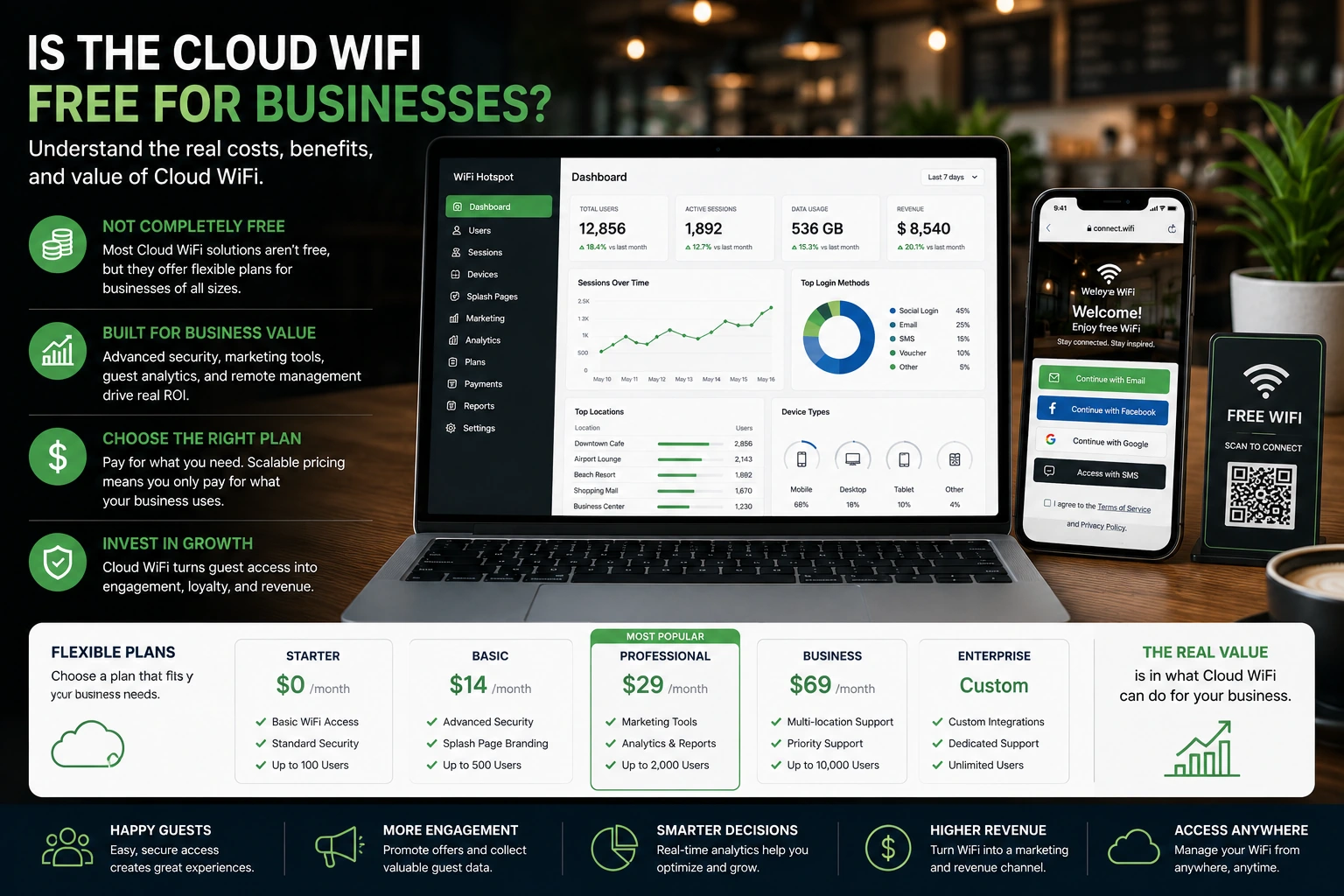
Is the cloud WiFi free in real-world deployments?
In real-world business deployments, cloud WiFi is rarely free once you define the full requirement. The hardware costs money. Internet backhaul costs money. Installation costs money. Ongoing monitoring, captive portal management, guest access controls, reporting, and technical support also cost money, whether they appear as license fees, subscriptions, or internal labor.
What creates confusion is that different vendors package those costs differently. One provider may include basic cloud management with the hardware. Another may charge per access point, per venue, or per user session. A third may offer a free entry plan but charge for the features that business operators actually buy cloud WiFi for, such as branded guest onboarding, social login, voucher access, payment collection, advertising, or centralized multi-location administration.
So the better question is not whether cloud WiFi is free. It is what level of cloud WiFi functionality is included, what is excluded, and what the business gives up in exchange for a lower upfront price.
What “free” usually means in cloud WiFi
In networking, free rarely means full-service. It usually means one of three things.
The first is hardware-bundled management. You buy access points, and the vendor gives you a basic dashboard with device status, firmware updates, and light configuration. This can work for simple environments, but it often stops short of serious guest WiFi management.
The second is a limited software tier. This model can be useful for trials, small pilots, or low-traffic locations. The trade-off is that session limits, branding restrictions, analytics caps, or support limitations tend to appear quickly.
The third is operationally free but not commercially free. A business may avoid a visible software bill while absorbing cost elsewhere through manual administration, fragmented reporting, weak monetization, or poor customer experience. That hidden cost is common in venues that treat WiFi as an afterthought until complaints, abuse, or missed marketing opportunities force a change.
Where the actual costs come from
Cloud WiFi pricing is not just a software question. It sits across network operations, customer experience, and revenue strategy.
At the infrastructure layer, you are paying for access points, switching, internet connectivity, power, coverage design, and support readiness. If the venue needs high density performance, roaming, VLAN segmentation, or multiple SSIDs, costs rise because the environment is more demanding.
At the software layer, cloud WiFi platforms charge for the functions that create centralized control. That can include captive portal hosting, splash page customization, user authentication, guest policy enforcement, radius integration, location-based management, analytics retention, advertising tools, survey collection, and API access.
At the business layer, the cost question changes again. A hospitality group may care about guest satisfaction and reduced front-desk WiFi complaints. A retailer may care about repeat visits and customer data capture. A transport operator may need time-based access, payment collection, and abuse controls. In those cases, cloud WiFi is not simply a utility. It is an operational and commercial platform.
When free cloud WiFi can make sense
There are cases where a free or nearly free setup is reasonable.
A small business with one location, simple internet access needs, and no requirement for guest data collection may do fine with entry-level cloud management. If there is no need for branding, no need for monetization, and no need for advanced reporting, paying for a larger platform too early may not produce a strong return.
The same applies to short-term pilots. A school testing managed guest access in one building or a small cafe validating a captive portal concept may start with a basic plan before expanding.
But even here, it depends on growth. Many businesses outgrow “free” faster than expected once they want one login journey across sites, more reliable support, better reporting, stronger content controls, or differentiated guest and staff access policies.
When free becomes expensive
The cost of free cloud WiFi shows up when scale, accountability, or customer-facing performance matters.
If an IT team manages ten or fifty sites, time becomes a real expense. Manual changes across locations, inconsistent portal branding, limited audit trails, and scattered reporting create friction that does not appear on an invoice but reduces operational efficiency.
Security is another pressure point. Guest WiFi is public-facing by design. Businesses need separation from internal systems, acceptable use enforcement, login control, abuse mitigation, and records that support policy compliance. Free tools may offer basic segmentation, but not the depth needed for regulated sectors or large public venues.
Then there is revenue. In hotels, airports, transit, events, and public-facing retail, WiFi can support paid access, targeted promotions, video advertising, sponsorships, and customer profiling. If the platform cannot support those outcomes, the cheapest option may actually cost the business more in missed opportunity than a paid solution would.
Is the cloud WiFi free if you need guest management features?
If you need true guest management, the answer is almost always no. Guest WiFi that performs like a business system requires more than internet access.
You may need branded splash pages that match the venue or chain identity. You may need vouchers, SMS login, email login, social login, PMS integration, time quotas, bandwidth controls, and role-based access. You may need payment acceptance for premium access or longer sessions. You may need centralized reporting to compare venue performance across a portfolio.
Those are not side features. They are the reason many organizations move to cloud-managed guest WiFi in the first place.
This is where platforms such as Start Hotspot fit clearly into the market. The value is not “free WiFi.” The value is controlled WiFi that can be branded, monetized, measured, and managed across one site or many.
How to evaluate cloud WiFi pricing the right way
A better buying approach is to compare total business value, not just subscription cost.
Start with the operational requirement. How many sites, access points, guest users, and administrators are involved? Do you need centralized management, local survivability, white-label support, or on-premise deployment for policy reasons? A single-site coffee shop and a regional hospital system should not evaluate cloud WiFi the same way.
Then assess the customer journey. If WiFi is part of the brand experience, free tools with generic captive portals and limited customization may hurt more than they help. A poor login flow, weak mobile experience, or inconsistent branding creates friction at the exact point where the customer is trying to connect.
Finally, model business outcomes. If analytics, promotions, surveys, payment collection, or ad delivery matter, the platform should be judged by what it enables, not just by what it costs per month. In many environments, a paid cloud WiFi platform justifies itself by reducing support load and creating measurable commercial return.
The practical answer for buyers
So, is the cloud wifi free? Not in the form that most serious business environments require. Some parts may be included. Some entry tiers may be free. Some vendors may reduce visible software fees by shifting limits elsewhere. But once you need policy control, branded guest access, security segmentation, analytics, monetization, or multi-site administration, cloud WiFi becomes a managed business system with real cost and real value.
That is not a negative. It is the same logic businesses apply to any system that supports operations and revenue. The right question is whether the platform gives you enough control, flexibility, and commercial upside to justify the spend.
If your venue only needs simple internet sharing, free may be enough for now. If your WiFi needs to support the brand, the network, and the business model, free is usually where the limitations start to show.
Frequently Asked Questions
Why does business Cloud WiFi usually have a recurring cost?
Professional systems provide centralized management, authentication, monitoring, captive portals, analytics, security controls, updates, and support that go beyond basic wireless connectivity.
Can a small business use Cloud WiFi without advanced features?
Yes. A small business may need only basic centralized management and guest access, while marketing, billing, analytics, or advanced authentication can become relevant as requirements grow.
Is Cloud WiFi cheaper than managing WiFi locally?
It depends on scale. Local management may cost less for one simple site, while centralized management can reduce administration and support costs across multiple locations.
Prefer Antamedia on Google
Get practical guest WiFi and network management insights directly from Antamedia.