
Restaurant Guest WiFi Marketing That Works
In Brief: Restaurant guest WiFi marketing turns guest internet access into a consent-based channel for collecting customer data, delivering offers, gathering feedback, and encouraging repeat visits. A branded captive portal combined with segmentation, analytics, and automated campaigns can help restaurants measure engagement while keeping guest access simple and secure.
The lunch rush is over, but your dining room is still full of signals. Every guest who opens a phone and asks for the password is creating a marketing moment. Restaurant guest wifi marketing turns that routine request into a controlled channel for customer data capture, repeat visit campaigns, surveys, offers, and measurable revenue activity.
For operators, that matters because foot traffic alone is not enough. Rising acquisition costs, margin pressure, and fragmented customer journeys make it harder to build loyalty. For IT teams, open access with no policy, branding, or visibility creates avoidable risk. A properly managed guest WiFi system gives both sides what they need - secure access for guests, centralized control for administrators, and a practical marketing layer for the business.
What restaurant guest wifi marketing actually does
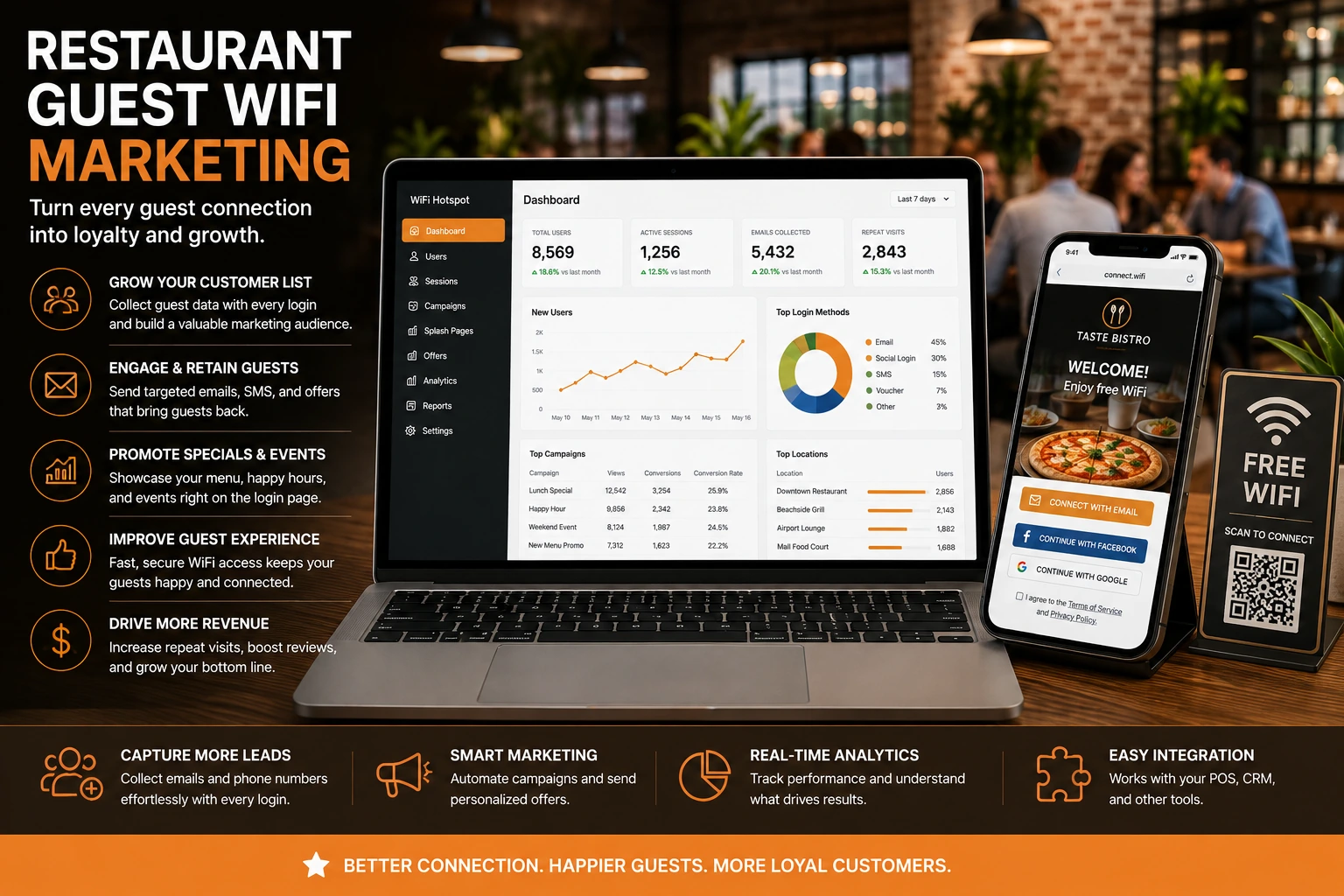
At its core, restaurant guest wifi marketing connects internet access with customer engagement. Instead of handing out a shared password and losing visibility, the venue presents a branded login experience through a captive portal. Guests connect, accept terms, and optionally provide information such as email, phone number, social login details, location consent, or survey responses.
That data can feed marketing workflows, audience segmentation, and campaign reporting. A casual dining group might invite first-time visitors to join a loyalty program. A quick-service chain might show a time-limited lunch offer before access is granted. A franchise operator might compare engagement and visit behavior across multiple locations from one dashboard.
The value is not just in collecting contacts. It is in creating a repeatable system that ties digital engagement to physical venue traffic. When guest WiFi is managed correctly, each login can support remarketing, feedback collection, on-site advertising, and even monetization strategies where appropriate.
Why restaurants are moving beyond free internet
Free WiFi used to be a simple guest amenity. Today, it is part of the operating stack. Restaurants need more than connectivity because customer expectations have changed. Guests want fast, easy access. Operators want to know whether that access is helping retention, improving reviews, increasing order frequency, or supporting promotions.
This shift is especially visible in multi-location environments. One store manager may only need a branded login page and a basic survey. A regional brand may need centralized policy control, role-based administration, analytics, and integrations with CRM or loyalty systems. The same access layer has to support marketing goals without creating complexity for IT.
There is also a trade-off to manage. The more fields you place in front of a guest, the lower your completion rate can become. A long registration form might produce richer data, but it may also frustrate customers who only want quick access while they wait for a table. Strong restaurant guest wifi marketing balances friction and conversion. The best deployments ask for only what the business can actually use.
Building a restaurant guest wifi marketing strategy
A useful strategy starts with the venue model. Full-service restaurants, coffee shops, food halls, and quick-service locations have different traffic patterns and dwell times. That changes what should happen on the login page and after the session begins.
If guests stay for an hour, there is more room for surveys, video advertising, or loyalty prompts. If the average stay is 12 minutes, access must be almost immediate. In that case, lightweight data capture and strong post-visit automation usually perform better than heavy login requirements.
The next decision is your primary objective. Some restaurants want first-party customer data. Others want to increase app downloads, promote upsells, collect reviews, or understand return visit trends. Trying to force every goal into one portal usually weakens results. One or two high-value actions are better than six competing messages.
A good setup also separates brand consistency from local flexibility. Corporate teams should control templates, access policies, and compliance standards. Local operators should still be able to rotate promotions by daypart, event, or location. That structure is what makes the platform scalable rather than just functional.
The infrastructure behind the marketing result
Marketing performance depends on network reliability more than many operators expect. If access is slow, unstable, or difficult to join, guests drop off before they ever see the offer. That is why restaurant guest wifi marketing cannot be treated as a standalone campaign tool. It has to sit on top of stable guest access management, bandwidth controls, policy enforcement, and centralized administration.
This is where infrastructure decisions matter. Cloud-managed deployments are often the fastest route for growing restaurant groups because they simplify rollout, branding updates, and analytics across locations. On-premise options may make more sense where organizations need stricter internal control, custom network architecture, or local compliance requirements.
Hardware compatibility also affects long-term cost and flexibility. Restaurants rarely want to rebuild their environment every time they upgrade marketing features. A platform that works across supported access points, controllers, and gateway models reduces lock-in and shortens deployment cycles.
Security should not be an afterthought. Guest traffic must remain isolated from POS systems, back-office devices, kitchen equipment, and staff networks. Captive portals, authentication policies, session limits, content controls, and audit visibility all support a better customer experience because they reduce operational risk.
Metrics that matter more than logins
Too many guest WiFi projects stop at connection counts. That is a weak marketing measure. A restaurant can have thousands of sessions and still learn very little about customer behavior or campaign effectiveness.
More useful metrics include login conversion rate, repeat visit rate, email or SMS opt-in rate, average session duration, campaign redemption, survey completion, and location-level performance over time. For chains, cross-location comparisons are especially valuable. They can reveal whether strong results come from better staffing, better portal design, stronger offers, or simply higher traffic.
It also helps to distinguish between vanity activity and commercial outcomes. A high number of social logins may look positive, but if those users never return or convert into a measurable audience segment, the business value is limited. By contrast, a smaller set of verified contacts that receive targeted offers and return within 30 days is much more meaningful.
Operators should also watch abandonment points. If many guests reach the portal but do not complete access, the issue may be page load time, mobile formatting, excessive consent steps, or a weak value exchange. Fixing that can produce a faster revenue impact than launching another campaign.
Common mistakes in restaurant guest WiFi deployments
The most common mistake is treating WiFi as either pure infrastructure or pure marketing. It is both. If IT controls it without commercial input, the business misses customer engagement opportunities. If marketing controls it without network discipline, the guest experience suffers.
Another mistake is collecting data with no follow-up plan. Capturing email addresses sounds productive, but unused data has no operational value and creates unnecessary compliance exposure. Restaurants should define how contacts are segmented, how often they are messaged, and what offer logic applies before the portal goes live.
Many venues also overcomplicate the first interaction. A branded page is useful. A crowded page with too many fields, banners, and calls to action is not. Restaurants usually get better results when the login journey is fast, mobile-friendly, and focused on one conversion goal.
Finally, some operators fail to think past a single location. Even if the business is small today, it is worth choosing a system that can support multiple sites, role-based permissions, reporting by venue, and future monetization options. Replacing a basic hotspot later is usually more expensive than deploying a scalable model from the start.
Where the strongest ROI usually comes from
The highest return rarely comes from internet access itself. It comes from what the platform enables after connection. Repeat visit messaging, loyalty enrollment, guest feedback, coupon delivery, sponsored splash pages, premium access models, and audience analytics all add value when they are tied to venue goals.
For a restaurant group, this can become a disciplined performance channel rather than a convenience feature. Marketing teams gain a direct touchpoint inside the venue. IT teams gain visibility and control. Operators gain a clearer view of which locations, promotions, and customer segments produce results.
That is the real case for restaurant guest wifi marketing. It gives restaurants a way to turn existing foot traffic into usable customer intelligence and measurable growth without adding friction to front-of-house operations. With the right platform, the login page stops being a technical checkpoint and starts working like part of the business.
If your guest network is already carrying the traffic, it should also be carrying more of the commercial load.
Prefer Antamedia on Google
Get practical guest WiFi and network management insights directly from Antamedia.