
What Features Should a Business WiFi Platform Have?
In Brief: A business WiFi platform should combine centralized multi-location management, guest authentication, access policies, security, analytics, hardware flexibility, and customer-facing tools such as captive portals and marketing. The right feature set depends on the organization’s network scale, operating model, security requirements, and how guest WiFi contributes to business goals.
A guest complains that WiFi worked in the lobby but dropped in the conference room. Marketing wants branded login pages and campaign data. IT wants one dashboard, not twenty. That tension is exactly why the right business WiFi platform features matter - not as a checklist, but as the difference between a network that simply broadcasts internet and one that supports operations, customer experience, and revenue.
For hotels, restaurants, airports, healthcare sites, campuses, and retail groups, cloud WiFi is no longer just about coverage. The right platform has to manage access, enforce policy, support multiple venues, and turn guest connectivity into something measurable. Some features are essential from day one. Others become critical as you scale, add locations, or start using WiFi as a business channel instead of a utility.
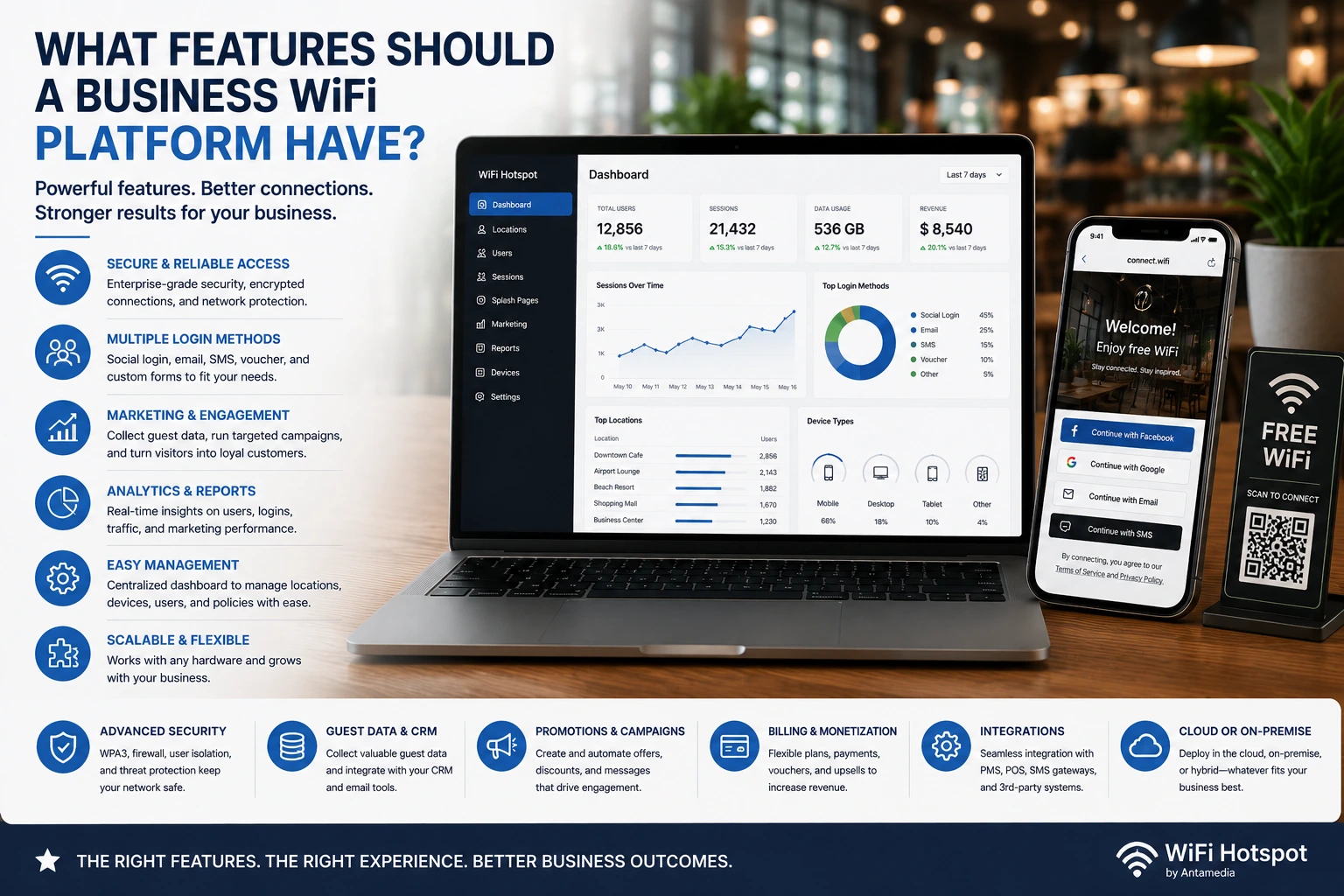
What Business WiFi Features Should Actually Solve
The best way to evaluate cloud WiFi is to start with outcomes. A venue operator usually wants easier administration, a better guest experience, and fewer support issues. An IT team wants centralized control, hardware flexibility, policy enforcement, and visibility across sites. Leadership often wants proof that WiFi can support loyalty, advertising, payments, or customer data collection.
That means the strongest platforms do more than manage access points. They combine networking controls with customer-facing workflows. If a feature only helps configure radios but does nothing for guest onboarding, monetization, analytics, or compliance, its value is narrower than many buyers expect.
1. Centralized multi-site management
This is the feature that changes the operating model. A true cloud WiFi platform should let teams provision, monitor, and update multiple locations from one interface. That includes access points, SSIDs, captive portals, bandwidth rules, user policies, and reporting.
For a single cafe, centralized management is convenient. For a hotel group, restaurant chain, airport operator, or managed service provider, it is operationally necessary. Without it, routine changes turn into site-by-site manual work, and consistency breaks down fast.
There is a trade-off, though. Some environments still need on-premise control for policy, regulatory, or infrastructure reasons. In those cases, hybrid or self-hosted options may be the better fit than a pure public cloud model.
2. Captive portal and branded guest access
Guest WiFi starts at login, and that experience shapes perception immediately. A strong captive portal system should support branded splash pages, custom authentication paths, terms acceptance, and location-specific designs. This matters because guest access is part of the customer journey, not just a technical gateway.
For hospitality and retail, branding reinforces trust and gives the network a business function. For healthcare, education, and public venues, it helps organize access rules for different user groups. The key is flexibility. A platform should allow simple click-through access where speed matters, but also support vouchers, room-based login, social login, email capture, or paid access where the business model demands it.
Too much friction can hurt adoption. Too little control can create abuse or missed opportunities. The right setup depends on venue type, dwell time, and user expectations.
3. Policy-based access control and user segmentation
Not every user on the network should get the same experience or the same privileges. One of the most important business WiFi capabilities is policy control that separates guests, staff, tenants, students, contractors, or premium users
This is where operational value and security meet. Staff devices may need higher priority and access to internal systems. Guests should be isolated from business resources. Paid or loyalty users may get more bandwidth or longer session times. In a hospital or campus environment, segmentation becomes even more important because the mix of users is broader and the risk profile is higher.
Good platforms make these policies manageable without requiring constant command-line intervention. The more locations you manage, the more important policy templates and automated enforcement become.
4. Bandwidth management and quality controls
A guest network can fail even when internet service is technically up. If one user starts heavy downloads or streaming, everyone else feels it. Cloud WiFi should include bandwidth shaping, session limits, fair usage controls, and traffic prioritization.
This is especially important in venues where expectations are high and user density changes throughout the day. Hotels need stable service at night when streaming spikes. Cafes need responsiveness during short visits. Airports and event venues need systems that can absorb sharp surges without collapsing into a support problem.
Quality controls are also where business intent matters. Some operators want free basic internet with the option to upsell premium speed. Others want to protect point-of-sale, VoIP, or operational apps ahead of guest traffic. The feature matters, but the policy design matters just as much.
5. Analytics that go beyond usage totals
A dashboard with connected device counts is useful, but it is not enough. Better cloud WiFi platforms provide analytics on sessions, repeat visits, dwell time, login conversion, traffic peaks, campaign performance, and venue-level trends.
For commercial operators, this is where WiFi starts producing business intelligence. Retailers can compare location traffic patterns. Hospitality teams can see guest engagement with branded login pages. Airports and transit operators can monitor demand by zone and time period. Educational and public institutions can better understand capacity and service needs.
The main caution is data quality. Analytics only help if identity capture, consent handling, and reporting structure are configured correctly. Raw numbers without segmentation or business context tend to create noise, not decisions.
6. Marketing and monetization tools
This is where guest WiFi becomes more than network access. Many businesses now expect cloud WiFi to support social login, email capture, promotions, surveys, video ads, coupon delivery, and paid internet plans.
Not every venue needs every monetization feature. A hospital may focus more on visitor access and satisfaction feedback. A mall or restaurant group may care more about repeat visits, campaign attribution, and promotional messaging. A transportation hub may want payment acceptance for premium access. The point is that the platform should support these use cases without bolting on separate systems for every function.
WiFi Hotspot platforms can combine guest access control with marketing, payments, analytics, and centralized administration, reducing the need for separate systems.
7. AAA, RADIUS, and enterprise-grade authentication
For larger organizations, guest WiFi is only one part of the environment. They may also need staff authentication, role-based access, usage accounting, and integration with existing identity systems. Cloud WiFi platforms serving enterprise, campus, government, and service provider environments should support AAA and RADIUS workflows.
This capability is easy to overlook if you only think in terms of public hotspots, but it becomes critical in mixed-use networks. A school district, bank, airport, or healthcare system may need very different authentication paths for visitors, employees, and managed devices.
Smaller businesses may not need advanced AAA on day one. Still, buying a platform that can support it later can prevent a painful migration when requirements grow.
8. Hardware compatibility and deployment flexibility
One of the most practical business WiFi requirements is broad hardware support. Businesses rarely want to rip and replace every access point just to adopt better management software. A platform that works across multiple vendors gives operators more freedom in procurement, upgrades, and phased rollouts.
Deployment flexibility matters too. Some organizations want cloud-hosted management for speed and simplicity. Others need on-premise or private deployment because of compliance, data control, or internal policy. A good platform respects both realities.
This is often where total cost of ownership shifts. Software that looks inexpensive can become costly if it forces hardware lock-in or limits deployment models.
9. Alerts, monitoring, and remote troubleshooting
A cloud WiFi platform should not just show configuration status. It should help teams identify issues quickly with health monitoring, outage alerts, client visibility, and remote diagnostics.
For distributed operations, this reduces truck rolls and shortens resolution time. An MSP can isolate a site issue before the customer calls. A hotel IT team can spot overloaded access points during an event. A retailer can detect recurring WAN or device failures across specific stores.
The difference between basic monitoring and useful monitoring is actionability. If alerts are too noisy or too vague, teams start ignoring them. Better systems surface the issues that actually affect service quality.
10. Security, compliance, and auditability
Guest WiFi always creates some level of risk. The platform should support secure onboarding, user isolation, logging, consent capture, and administrative controls that make activity traceable. In many environments, this is not optional. It is part of operating responsibly.
Requirements vary. A small cafe may mainly need acceptable use enforcement and basic session logs. A healthcare provider, school, airport, or public institution may need stronger recordkeeping, role separation, and tighter policy control. That is why security features should be judged against the real environment, not generic marketing claims.
How to prioritize features by business type
Not every buyer should score these features the same way. A restaurant group may prioritize branded login, loyalty capture, and centralized management. A hotel operator may put bandwidth control, premium access, and guest analytics near the top. An enterprise campus or government deployment may care most about authentication depth, segmentation, and deployment architecture.
The mistake is treating all cloud WiFi feature sets as equal because they share a dashboard and a login portal. The real question is whether the platform helps your team operate faster, control risk better, and get more business value out of every guest connection.
If you are evaluating platforms, ask a simple question at every step: does this feature reduce complexity, improve user experience, or create measurable commercial value? The best cloud WiFi systems do all three, and that is usually where the long-term decision becomes clear.
Frequently Asked Questions
Which WiFi features matter most for a multi-location business?
Centralized administration, policy management, remote monitoring, guest authentication, analytics, security controls, and location-specific configuration become increasingly important as the network grows.
Should a business WiFi platform support existing hardware?
Ideally, yes. Broad hardware compatibility can reduce migration costs and allow businesses to retain supported routers, access points, and controllers.
Do all businesses need WiFi marketing and monetization features?
No. These features are valuable for customer-facing environments, while healthcare, education, or corporate deployments may prioritize security, identity, reliability, and policy enforcement.
Prefer Antamedia on Google
Get practical guest WiFi and network management insights directly from Antamedia.