
PMS-Integrated WiFi Platform Review Guide
In Brief
A PMS-integrated WiFi platform should connect hotel reservation status with guest authentication, access policies, billing, and checkout while minimizing manual work for front-desk staff. When comparing platforms, hotels should verify PMS compatibility, integration method, guest workflows, network controls, data governance, reporting, and how exceptions such as room moves, extensions, and PMS outages are handled.
A hotel guest who must re-enter a voucher code after checking in has already found a gap between the property management system and the network. A useful PMS integrated WiFi platform review should focus on whether the platform turns reservation data into a reliable guest access experience while giving hotel teams control over security, support, revenue, and reporting.
For a single boutique property, basic room-based access may be enough. For a hotel group, resort, or managed service provider, the standard is higher. The WiFi platform must handle changing reservations, group arrivals, multiple brands, varied access policies, and centralized administration without creating extra work for the front desk or network team.
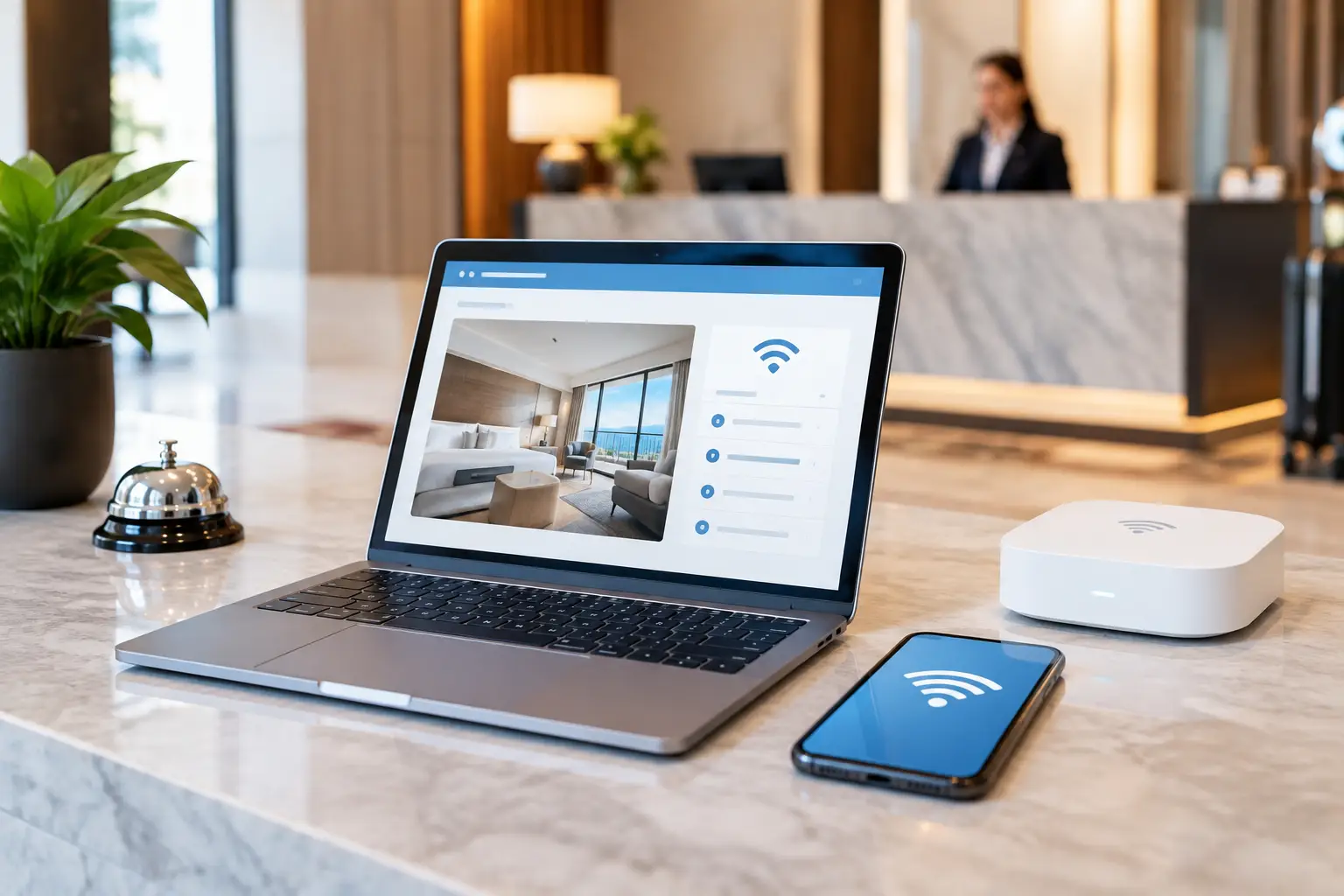
What a PMS-integrated WiFi platform must do
PMS integration is not simply a login page that asks for a room number and last name. The platform needs a defined and dependable way to validate a guest against PMS data, apply access rights, and remove or change those rights when the reservation changes.
At minimum, assess how the platform handles check-in, check-out, room moves, extensions, early departures, and multiple guests associated with one room. A guest should receive the right access policy based on their current stay status, not a static credential that remains active after departure. This matters for both experience and security.
The integration method also deserves scrutiny. Depending on the PMS and property environment, connectivity may use an API, a certified interface, middleware, or scheduled data exchange. Each approach has trade-offs. APIs can support timely updates but may require approved credentials and version management. Middleware can simplify compatibility across systems but adds another component to monitor. File-based exchange may fit legacy environments, although it can introduce delays that affect arrivals and reservation changes.
A credible vendor should clearly define supported PMS systems, required licenses, data fields exchanged, update timing, fallback behavior, and responsibility for troubleshooting. Do not treat the word integration as a substitute for those details.
PMS integrated WiFi platform review: the guest journey
The best test is to map the guest journey from reservation to checkout. Before arrival, determine whether the platform can recognize pre-registered guests or support a branded pre-arrival message when permitted by the property. At arrival, the login process should be understandable on mobile devices and should not require front-desk staff to explain technical steps during a busy check-in period.
Once authenticated, the guest should be assigned to the correct access tier. A standard guest may receive a complimentary internet policy, while a premium package, meeting attendee, loyalty member, or long-stay guest may receive different speeds, device limits, or paid options. The platform should support those distinctions without forcing staff to create manual accounts.
Room-based credentials need careful design. Some properties allow a room number and surname, while others require a PMS-generated credential, booking reference, or additional verification step. Convenience and fraud prevention must be balanced. A simple room-number workflow may reduce friction, but it can be weak if the system does not rate-limit failed attempts or protect against room-number guessing.
Check-out is equally revealing. Access should end, downgrade, or move to a public guest policy according to the hotel’s rules. If the PMS is temporarily unavailable, the WiFi system should have a documented contingency process so guests are not disconnected unnecessarily and staff are not left without a support path.
Evaluate the commercial value, not just connectivity
Hotel WiFi is an operating service, but it can also support direct revenue and customer engagement. A platform worth considering should let the property present branded portal pages, terms of use, language choices, promotional messages, surveys, and service information before or after authentication.
Paid access is one area where requirements vary sharply. Some hotels need simple card payments for premium bandwidth. Others require charges posted to the guest folio, vouchers issued by reception, conference access codes, or sponsor-funded access. Verify exactly which billing flows are supported with the selected PMS, payment gateway, and deployment model. A payment page alone is not the same as folio posting.
Marketing capabilities should remain useful without becoming intrusive. Consent-based data capture, campaign attribution, on-portal video advertising, and post-stay feedback can create measurable value when they align with the property’s privacy policy and guest expectations. For a luxury property, the portal may need to be restrained and service-led. For an airport hotel or resort, promotions for upgrades, dining, events, and local partners may have stronger commercial value.
Analytics should connect activity to operational decisions. Look for reports on authentications, active users, bandwidth consumption, device counts, access method, payment activity, survey results, and location-level performance. Multi-property operators need the ability to compare locations while preserving local branding and policy differences.
Network control and security requirements
A PMS connection should never weaken the underlying network design. Guest traffic must remain segmented from hotel operations, point-of-sale systems, staff devices, building systems, and payment environments. The WiFi platform should work with the property’s VLAN, firewall, access point, gateway, and routing design rather than forcing an insecure shortcut.
For IT teams, centralized policy management is a major advantage. Administrators should be able to define bandwidth limits, session duration, device allowances, content controls where appropriate, quota policies, and acceptable-use terms by guest type or property. Radius and AAA support are particularly relevant for larger environments that require consistent authentication and accounting across controllers, gateways, or distributed sites.
Review the operational controls as closely as the guest-facing features. Useful capabilities include role-based administration, audit logs, location-level permissions, remote configuration, portal template management, session visibility, and diagnostic data for support teams. If a hotel group uses multiple hardware vendors or has a mix of cloud-managed and legacy infrastructure, hardware compatibility and deployment flexibility can influence the decision more than portal design.
Data governance also needs a direct answer. Ask what personally identifiable information is collected, where it is stored, how long logs are retained, how consent records are handled, and whether the platform supports the property’s regional privacy obligations. The goal is to collect data that has a defined business purpose, not to accumulate guest information without controls.
How to compare platforms before deployment
A practical evaluation should start with the property’s actual workflow rather than a generic feature checklist. Build a test scenario that includes a normal reservation, a group booking, an early checkout, a room transfer, a late extension, and a PMS outage. Then ask the vendor to demonstrate what the guest, front desk, and network administrator each see at every stage.
Use the following review areas to keep the selection focused:
PMS behavior: Validate supported PMS versions, reservation fields, sync frequency, exception handling, and whether access changes happen automatically.
Guest access: Test room-based login, voucher access, social or email login where appropriate, multilingual portals, device registration, and reconnect behavior.
Revenue workflows: Confirm payment acceptance, premium plans, voucher controls, folio posting requirements, taxes, refunds, and reporting ownership.
Network operations: Review hardware compatibility, Radius support, bandwidth policy, segmentation, monitoring, alerting, and remote administration.
Deployment model: Compare cloud-hosted, on-premise, and hybrid options against property security policies, internet reliability, and internal IT resources.
Scale and support: Assess tenant separation, white-label needs, bulk configuration, API availability, implementation services, service-level commitments, and escalation procedures.
A pilot should include real front-desk users and representative guest devices, not only an IT lab test. The front desk will quickly identify confusing login states. Guests will expose captive portal browser behavior, roaming issues, and device-specific limitations. The network team will identify whether session records, error logs, and policy controls are sufficient to resolve incidents efficiently.
When the right choice depends on the property
A limited-service hotel may prioritize fast deployment, simple PMS validation, and low administrative overhead. A full-service hotel may need premium bandwidth plans, conference access, deeper branding, and integrated payment workflows. Resorts and multi-building properties often need stronger roaming support, outdoor coverage planning, and location-aware policies. Enterprise hotel groups and managed service providers typically require multi-tenant administration, standardized templates, delegated permissions, and flexible deployment options.
The strongest platform is not necessarily the one with the longest feature list. It is the one that fits the PMS environment, network architecture, guest promise, and commercial model without creating manual exceptions at every property.
Antamedia WiFi Hotspot and Enterprise WiFi System can be evaluated against these requirements by confirming the required PMS interface and then reviewing guest authentication, captive portal workflows, billing, access policies, analytics, and administration for each property. A WiFi platform earns its place when it makes guest access easier to deliver and turns the network into an asset the business can actively manage.
Frequently Asked Questions
What should hotels verify before choosing a PMS-integrated WiFi platform?
Hotels should confirm the exact PMS product and version, supported integration method, required interface licenses, guest authentication workflow, check-in and checkout behavior, billing requirements, and responsibility for troubleshooting the integration.
Can PMS-integrated WiFi automatically end access at checkout?
Yes, when the integration supports reservation-status updates and the hotel configures access policies accordingly. Room moves, stay extensions, early departures, and temporary PMS outages should also be tested before deployment.
Can WiFi charges be posted directly to a guest room?
Yes, where the PMS interface and integration support folio posting. Hotels should verify the exact billing workflow because accepting an online payment is not the same as posting a charge to the guest room.
Should a hotel test PMS WiFi integration before full deployment?
Yes. A pilot should include real reservation scenarios, front-desk staff, representative guest devices, room changes, early checkout, stay extensions, and a simulated PMS outage.