
WiFi Vouchers vs Access Codes for Guest WiFi
In Brief
WiFi access codes provide a simple way to connect guests, while individual vouchers add stronger control through defined validity, session duration, device limits, bandwidth policies, and usage tracking. Shared codes work well for low-friction complimentary access, while vouchers are better suited to paid WiFi, high-traffic venues, accountable access, and situations where each guest or transaction needs its own policy.
A hotel front desk should not have to troubleshoot guest WiFi during check-in. Neither should a cafe cashier, hospital receptionist, or airport help desk. The choice between wifi vouchers vs access codes determines how much control staff retain over guest access, how easily guests connect, and whether the network can support revenue, marketing, and compliance goals.
The two terms are often used interchangeably, but they describe different operating models. A voucher is usually a unique, policy-controlled credential generated by a hotspot platform. An access code is a broader term that may mean a shared password, a one-time code, a campaign code, or a voucher-like credential. That difference matters when guest WiFi must do more than provide internet access.
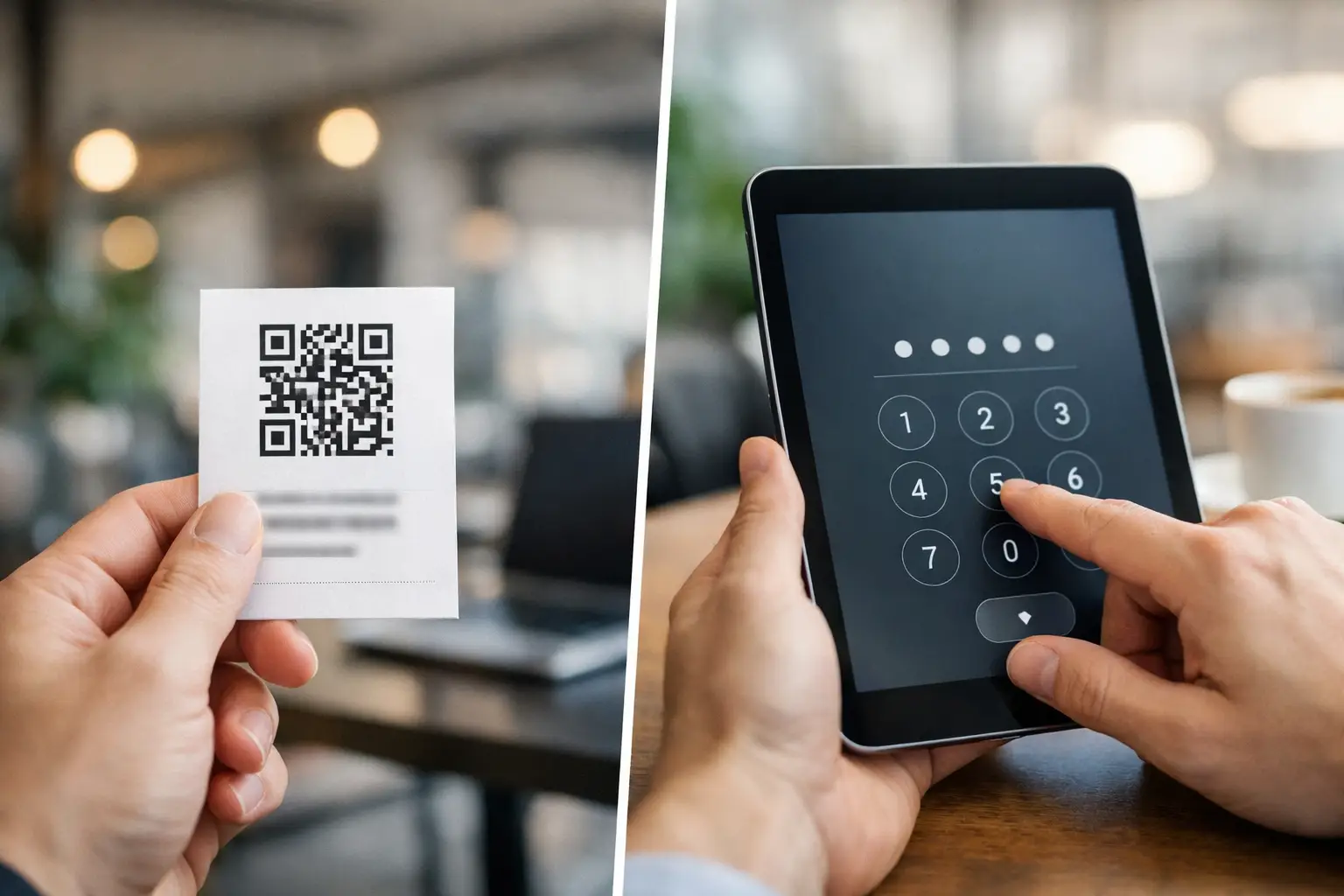
WiFi vouchers vs access codes: the practical difference
A WiFi voucher is typically issued to one guest, device, room, order, or transaction. It can carry rules before it is handed out: a four-hour session, 2 GB of data, one device, a specific speed tier, or access valid only on a certain date. Once the voucher expires or reaches its limit, access ends automatically.
Vouchers are commonly printed on receipts, issued at a front desk, delivered by SMS or email, or generated from a staff portal. Because each credential is unique, administrators can see when it was created, redeemed, and expired. They can also disable it without changing the experience for every other guest.
An access code may provide the same level of control, but it does not automatically do so. A restaurant might display one code on a tabletop sign and change it monthly. A hotel could send a code tied to a reservation. A retailer might use a campaign code that activates a branded captive portal promotion. The term describes the guest-facing credential, not necessarily the underlying access policy.
The key question is not whether guests type a voucher or a code. It is whether the credential is individual, time-bound, traceable, and connected to the right network policy.
Shared access codes prioritize speed
A shared code has a clear advantage in low-touch environments. Guests can enter one simple code, get online quickly, and avoid registration fields. For a small cafe offering complimentary WiFi with minimal staff involvement, that may be the right trade-off.
The downside is weak accountability. Once a shared code is photographed, forwarded, or posted online, it can spread well beyond the intended audience. Staff must change it manually, and changing it may disconnect or confuse legitimate guests. A shared code also offers little insight into which visit, customer, campaign, or staff interaction drove usage.
Shared codes work best when the network is low risk, guest volume is manageable, and convenience is more valuable than per-user control. They are less suitable for paid access, high-traffic public venues, regulated environments, or properties with recurring abuse issues.
WiFi vouchers prioritize policy and accountability
Vouchers are designed for operators that need to define exactly what a guest receives. A hotel can issue access that matches a room stay. A transit operator can provide a 30-minute session. A venue can distribute premium vouchers to event sponsors while offering a lower-speed complimentary tier to general visitors.
This model reduces staff guesswork. Instead of explaining a WiFi password that may or may not still be valid, an employee can issue a credential with a defined expiration and usage limit. For large venues, vouchers can be generated in batches for events, group bookings, conferences, or customer service desks.
There is a trade-off. Voucher workflows require a platform, a portal design, and a clear staff process. If attendants need to print or distribute vouchers, the process must be simple enough for busy shifts. The best implementations automate issuance where possible, such as connecting vouchers to booking systems, point-of-sale transactions, payment flows, or self-service kiosks.
Match the credential to the guest access model
The right choice depends on what the organization wants guest WiFi to accomplish. Free connectivity is only one outcome. Many operators also need segmentation, revenue collection, customer data, promotion delivery, or auditable access records.
Complimentary access with basic controls
For a small business, an access code can be sufficient if guest WiFi is isolated from business systems and the code is rotated on a defined schedule. A captive portal can still present terms of service and a branded welcome screen before granting access.
If code sharing becomes a problem, move to individual vouchers or one-time codes. This keeps the familiar guest experience while preventing a single credential from becoming a permanent pass for everyone nearby.
Paid WiFi and tiered service
Vouchers are usually the stronger option when access is sold. Each voucher can represent a purchased duration, data allowance, speed profile, or service class. Guests can pay through a captive portal, receive a credential, and return online without staff handling cash or manually changing settings.
Tiering is especially useful in hotels, airports, marinas, transit hubs, and event spaces. A business can offer a complimentary basic tier while charging for higher speed, longer duration, or multi-device access. The WiFi system should enforce the policy consistently rather than relying on staff to explain exceptions.
Sponsored and promotional access
Access codes can perform well for promotions when the code itself carries marketing value. A retailer may use a campaign code on signage, while a venue may distribute a sponsor-branded code during an event. However, a shared promotional code should still have guardrails, such as a short validity period, rate limits, or a portal flow that collects consent before access.
Vouchers provide stronger campaign measurement. A unique batch can be assigned to a specific event, partner, store, or advertising channel. Administrators can then compare redemption and session activity across campaigns instead of treating all guest traffic as one anonymous pool.
Security is about more than the code
Neither vouchers nor access codes replace network security architecture. A credential controls admission to the guest service. It does not, by itself, protect payment terminals, internal file shares, clinical systems, staff devices, or operational technology.
Guest traffic should be separated from internal networks through VLANs or equivalent segmentation, with appropriate firewall policies and client isolation. A captive portal should be backed by centralized authentication and accounting where required. Enterprises may also need AAA RADIUS integration, session logging, bandwidth controls, and on-premise deployment options for policy or data-governance reasons.
Unique vouchers improve accountability because activity can be associated with a specific credential. That is not the same as verified identity. If an organization needs verified contact details, consent capture, or customer matching, it should pair the access flow with registration, SMS verification, email validation, loyalty integration, or another approved identity process. Collect only the data the business can justify and manage responsibly.
Operational control at one site or one thousand
The administrative difference becomes much larger across multiple locations. A shared access code may be easy at one coffee shop but difficult to govern across hundreds of stores, properties, or public facilities. Different teams may create their own passwords, rotate them inconsistently, and lose visibility into who has access.
Centralized hotspot management turns credentials into a controlled service. Administrators can create standard voucher templates, define access policies by location, grant staff limited issuance rights, and review activity from a single console. A corporate operator can maintain brand consistency while allowing each site to issue access for local guests, events, or promotions.
Antamedia WiFi Hotspot and Enterprise WiFi System can support voucher-based and controlled guest access with captive portals, access policies, billing, analytics, advertising, and centralized administration. The value is not simply generating codes. It is applying the right access policy while creating a measurable guest interaction.
A practical decision rule
Choose a shared access code when the priority is fast, low-friction complimentary connectivity and the exposure from code sharing is acceptable. Choose unique vouchers when access must expire predictably, be sold, be allocated by staff or partners, or be traced back to a particular guest interaction.
For many organizations, the strongest design uses both. A simple complimentary code can support casual visitors, while vouchers handle paid plans, hotel guests, event attendees, service recovery, employee-issued passes, and premium access. The network can then serve different audiences without forcing every guest through the same process.
Guest WiFi performs best when the access method reflects the business model behind it. Define the experience you want guests to have, the policy you need to enforce, and the outcome you need to measure. The right credential becomes a practical control point for all three.
Frequently Asked Questions
What is the difference between a WiFi voucher and an access code?
A WiFi voucher is typically an individual credential linked to defined rules such as validity, session duration, bandwidth, device limits, or payment. An access code is a broader term and may refer to a shared password, one-time code, promotional code, or voucher-like credential.
When should I use a shared WiFi access code?
A shared access code is suitable when fast, low-friction complimentary access is more important than individual tracking or policy control, particularly in smaller and lower-risk venues.
When are WiFi vouchers the better choice?
Vouchers are better when access needs to expire automatically, be sold, have specific speed or duration limits, be issued to individual guests, or provide auditable usage and redemption records.
Can a business use both vouchers and shared access codes?
Yes. A venue can use a simple shared code for complimentary access while using individual vouchers for paid plans, premium access, hotel guests, events, or other controlled services.