
Cloud Controller vs Hardware Controller for WiFi
In Brief: Cloud WiFi controllers simplify centralized management, multi-location deployment, guest access, analytics, and policy updates without requiring a controller appliance at every site. Hardware controllers provide greater local control and independence, making them better suited to environments where local operation, infrastructure ownership, or strict data requirements are priorities.
A controller decision can shape far more than WiFi uptime. It determines how quickly a hotel can launch a branded captive portal, whether a restaurant group can update guest policies across 200 locations, and how much local infrastructure an airport must maintain. In the cloud controller vs hardware controller discussion, the right answer depends on operational requirements, network architecture, compliance obligations, and the commercial value expected from guest access.
For organizations operating guest WiFi, a controller is not simply an IT component. It is the control point for access policies, authentication, network visibility, user experience, and often revenue-producing services such as paid access, advertising, promotions, and data capture.
Cloud controller vs hardware controller: the core difference
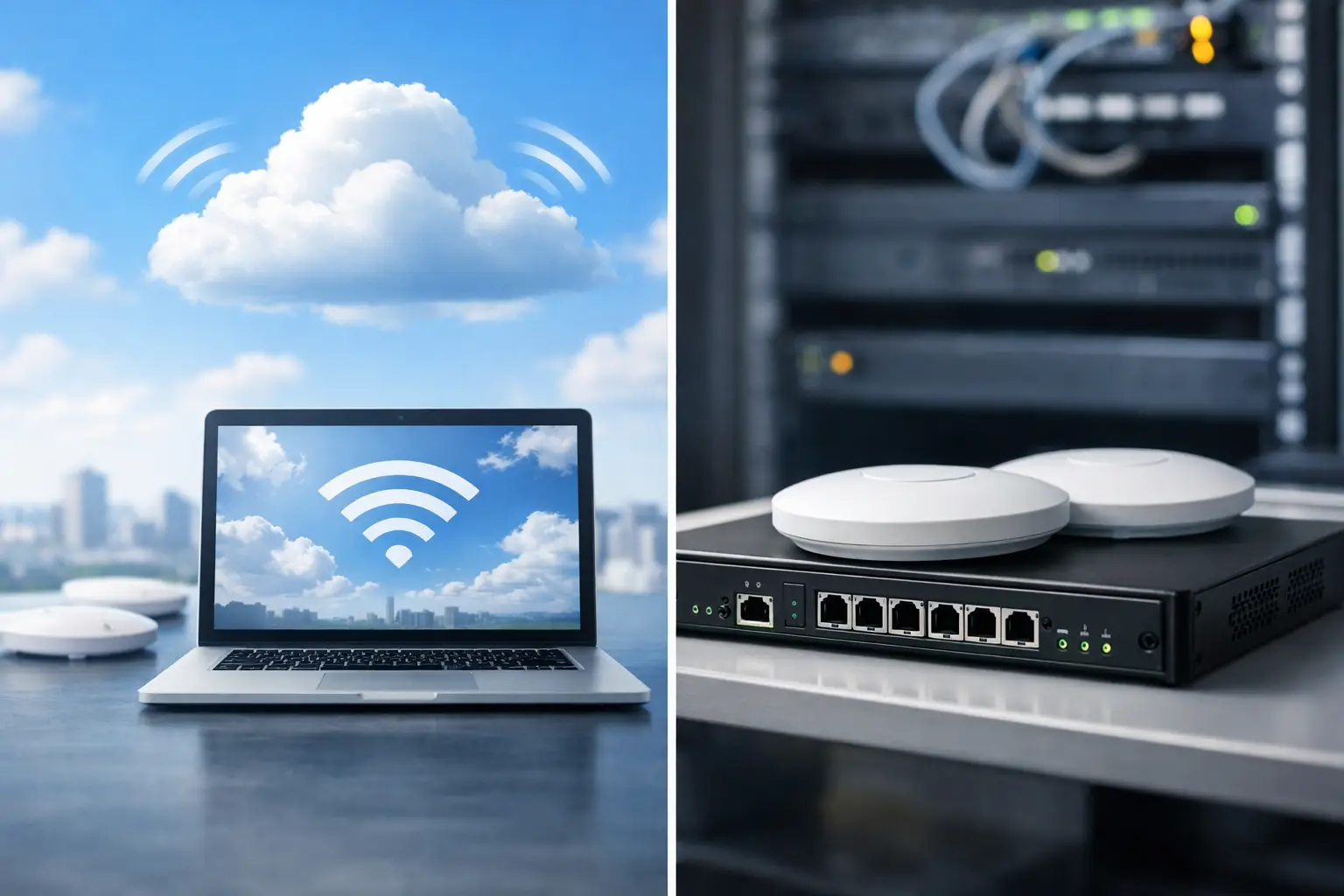
A hardware or on-premise controller typically runs within infrastructure controlled by the organization. It may be a dedicated physical appliance, a software controller, or a virtual machine deployed in a private data center or cloud environment. It manages access points, wireless policies, user authentication, and related services from infrastructure the organization owns or operates. Depending on the design, it may support local survivability, on-premise captive portals, AAA RADIUS, and direct integration with existing network equipment.
A cloud controller delivers management and policy control from a hosted platform. Administrators sign in through a web interface to configure locations, monitor access points, create guest policies, publish portals, and view analytics. The venue generally needs compatible access points, an internet connection, and a properly designed local network, while the management layer remains centralized in the cloud.
The terms can be misleading because products vary. Some cloud-managed WiFi platforms use a local gateway or virtual appliance for enforcement at the venue. Some hardware controllers can be managed remotely. Before comparing options, identify where policies are processed, where guest data is stored, what continues operating during an internet outage, and which functions require a local controller.
A WiFi controller and a guest WiFi management platform are not always the same system. The wireless controller may manage access points, radio settings, SSIDs, and local network functions, while a platform such as Antamedia WiFi Hotspot can provide captive portal authentication, guest access policies, bandwidth controls, payments, analytics, and marketing across supported routers, access points, and controllers.
Why cloud controllers fit multi-location guest WiFi
Cloud control changes the operating model for distributed networks. An administrator can onboard a new cafe, hotel, clinic, or retail branch without traveling to the site or configuring every location independently. Templates make it possible to apply a common SSID, acceptable-use policy, bandwidth policy, VLAN design, and branded portal across an entire estate while allowing local exceptions where needed. Centralized administration also makes it easier to manage WiFi access points across multiple locations while maintaining consistent policies, visibility, and guest access settings across the entire network.
This model is particularly effective when WiFi is part of the customer experience. Marketing teams can update portal imagery, launch a seasonal offer, add a survey, or change sponsored video content centrally. Operations teams can see which sites are offline or exceeding client capacity. IT can create staff, guest, contractor, and paid-access policies without handing each venue a separate management console.
Cloud platforms also reduce the up-front infrastructure burden. There is no controller appliance to size, procure, rack, power, patch, and replace at every site. That matters for small venues, temporary deployments, franchise networks, and organizations expanding quickly across regions.
For a business that wants WiFi to produce measurable outcomes, cloud architecture supports faster execution. A centralized platform can connect guest registration, social login, voucher access, payment acceptance, promotions, analytics, surveys, and advertising campaigns to the access workflow. The network becomes a managed customer touchpoint rather than a cost center with a password taped to a counter.
Where cloud management needs careful planning
Cloud management does not remove the need for reliable local network design. Access points still require correct placement, switching capacity, segmentation, power, and internet connectivity. A poorly designed LAN will not be repaired by a cloud dashboard.
Internet dependency is the main consideration. Many platforms allow access points to continue broadcasting previously applied configurations if the connection to the cloud is interrupted. However, real-time policy changes, centralized authentication, portal updates, reporting, and some guest login functions may be limited until connectivity returns. The exact behavior should be validated during evaluation, not assumed from a product label.
Organizations should also evaluate cloud WiFi security, including administrator access, data handling, audit logs, network segmentation, and role-based permissions. Cloud control is a strong fit when centralized speed outweighs the requirement to keep every service local.
When a hardware controller is the better fit
Hardware controllers remain relevant for organizations that require direct local control or have strict network and data governance rules. Hospitals, government facilities, large campuses, transportation hubs, and enterprises with restricted environments may need authentication and policy enforcement to stay inside their own network boundary.
A local controller can support operational continuity where WAN connections are unreliable or where a location cannot depend on external services for essential access. It can also align with established private-cloud, security operations, and procurement standards. For a large venue with dense device populations, a properly sized on-premise controller may offer predictable capacity planning and direct control over the wireless environment.
There is a trade-off. Hardware creates a lifecycle responsibility. Teams must account for appliance sizing, high availability, firmware updates, replacement schedules, power protection, backups, monitoring, and local technical support. A controller purchased for current demand may be undersized after a property expansion, a new terminal opens, or guest device counts rise.
Hardware costs are also not limited to the appliance price. Consider support contracts, spare units, data center space, engineering hours, and the cost of maintaining consistent policies across sites. For a single high-security campus, these costs may be justified. For 50 restaurants or 300 retail branches, they can become an unnecessary operational drag.
Organizations that require private infrastructure and greater local control can use an Enterprise WiFi System deployed on their own server or private cloud environment.
Compare the operating impact, not just the controller price
The purchase decision should be based on total operational value. A low-cost controller can be expensive if it requires constant site visits, limits portal customization, or cannot provide usable data to marketing and operations teams. A cloud subscription can be the stronger economic choice if it eliminates local management overhead and creates a path to monetize guest access.
Decision areaCloud controllerHardware controllerDeploymentFast central provisioning for many sitesLocal installation, sizing, and configuration requiredScalingAdd sites and access points through centralized administrationMay require controller upgrades or additional appliancesLocal outage behaviorDepends on cached configuration and local gateway designCan preserve local services when designed for on-premise operationGuest WiFi marketingCentral portal, campaign, survey, and analytics managementPossible, but may require additional local or integrated systemsInfrastructure ownershipLower on-site controller footprintFull local ownership and maintenance responsibilityCompliance controlRequires review of hosting and data handlingSupports strict local data and processing requirements
The comparison is not cloud good, hardware bad. It is a question of where control should live and how much operational effort the organization is prepared to carry.
Choose based on the guest WiFi outcome you need
For a multi-location business, start with the outcomes that matter. If the priority is consistent branding, centralized guest access policies, rapid site rollout, visitor analytics, lead capture, and paid or sponsored WiFi, a cloud-managed model is usually the practical choice. It gives IT, operations, and marketing a shared system instead of separate tools and disconnected site configurations.
If the priority is local autonomy, isolated operation, highly regulated data handling, or support for a large self-contained venue, a hardware controller or on-premise deployment may be the better fit. This is especially true when internal teams already have the expertise and infrastructure to operate it properly.
Some enterprises need both. A hybrid approach can retain local enforcement or a virtual controller for critical services while using cloud management for centralized visibility, portal administration, reporting, and multi-site policy coordination. This design can reduce compromise, but it must be architected carefully to avoid duplicate administration and unclear failure behavior.
For organizations that prefer hosted guest WiFi management, Antamedia WiFi Hotspot provides centralized captive portal management, authentication, access policies, payments, analytics, and WiFi marketing without requiring a local server.
Questions to answer before committing
Ask vendors to demonstrate a real outage scenario, not just a dashboard. What happens to new guest registrations if the venue loses internet access? Can existing guests remain online? Where are authentication records and consent logs stored? How are portal changes synchronized? What roles can local managers have without giving them access to the entire network?
Also test the commercial workflow. Can the system collect guest data with appropriate consent, present a branded offer, issue vouchers, accept payment, deliver ads, and report results by venue? If guest WiFi is expected to support loyalty, customer feedback, or direct revenue, these capabilities belong in the controller evaluation.
Before choosing either model, verify supported WiFi hardware and confirm that the platform works with the access points, routers, gateways, or controllers already deployed in the network.
Before selecting a platform, run a pilot at a representative site with real staff, real guests, and real failure conditions. The best controller is the one that keeps access controlled, operations manageable, and every connection useful to the business.
Prefer Antamedia on Google
Get practical guest WiFi and network management insights directly from Antamedia.